
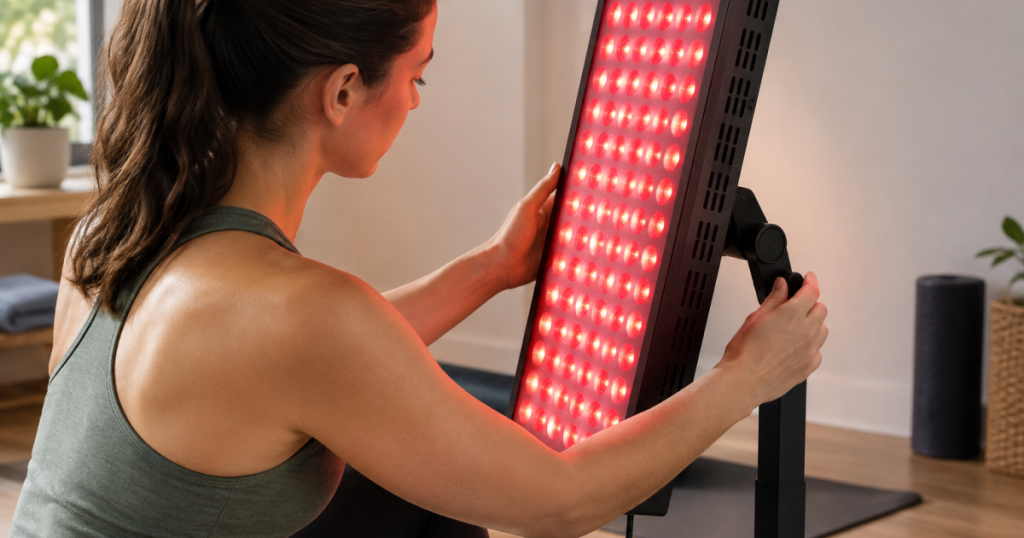
Getting panel distance right is less about chasing a perfect number and more about making time, coverage, and intensity work together. The red light therapy panel distance you choose determines how much light reaches skin, while session length determines how long that exposure continues. A good routine feels repeatable, not like a physics exam with a power cord.
Using a panel for diagnosed conditions, symptoms, eye disorders, photosensitivity, or medication-related light sensitivity is health-related and should be handled with a qualified healthcare professional in line with applicable care standards and safety requirements.
What to know first
Dose is usually described as fluence, measured in joules per square centimeter, or J/cm². In plain English, it is the amount of light energy delivered to a patch of skin. The rough math is:
Dose in J/cm² = irradiance in W/cm² × time in seconds.
So if a panel delivered 50 mW/cm² at the skin, that is 0.05 W/cm². A 10-minute session is 600 seconds, so the example dose would be 30 J/cm². If the same setup delivered 20 mW/cm², 10 minutes would equal 12 J/cm². These are math examples, not claims about any one panel.
Distance changes dose because light spreads out as it travels. With red light panels, the drop is not perfectly simple because LEDs, lenses, beam angles, and panel size all affect how light reaches the body. Still, the practical rule holds: closer usually means higher intensity over a smaller area; farther usually means lower intensity over a wider, more even area.
A useful distance framework
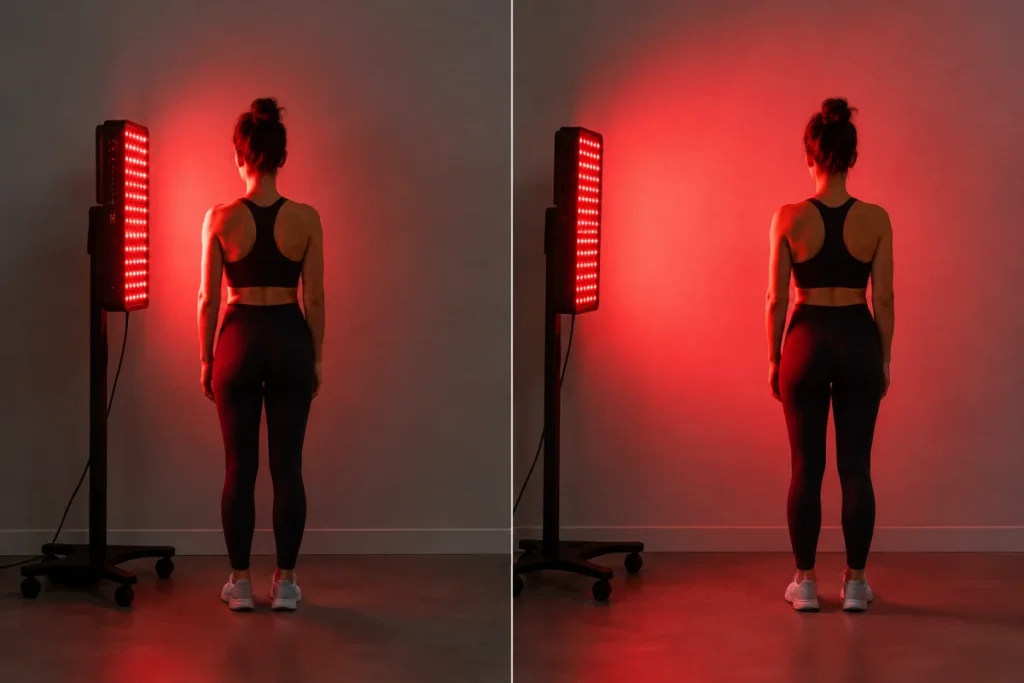
Most home users can think in distance bands rather than pretending there is one universal spacing. Start with the panel maker’s instructions, then use comfort, coverage, and consistency to refine from there.
Close range: about 6 to 12 inches
This range increases intensity and is often used when someone wants a shorter session on a smaller area. The trade-off is coverage. A close panel may leave shoulders, hips, or the sides of the body underexposed while the center gets much more light. It can also feel visually intense, especially with large red and near-infrared combo panels.
Use this range cautiously. It makes the most sense for targeted sessions, not casual full-body standing routines where evenness matters.
Middle range: about 12 to 24 inches
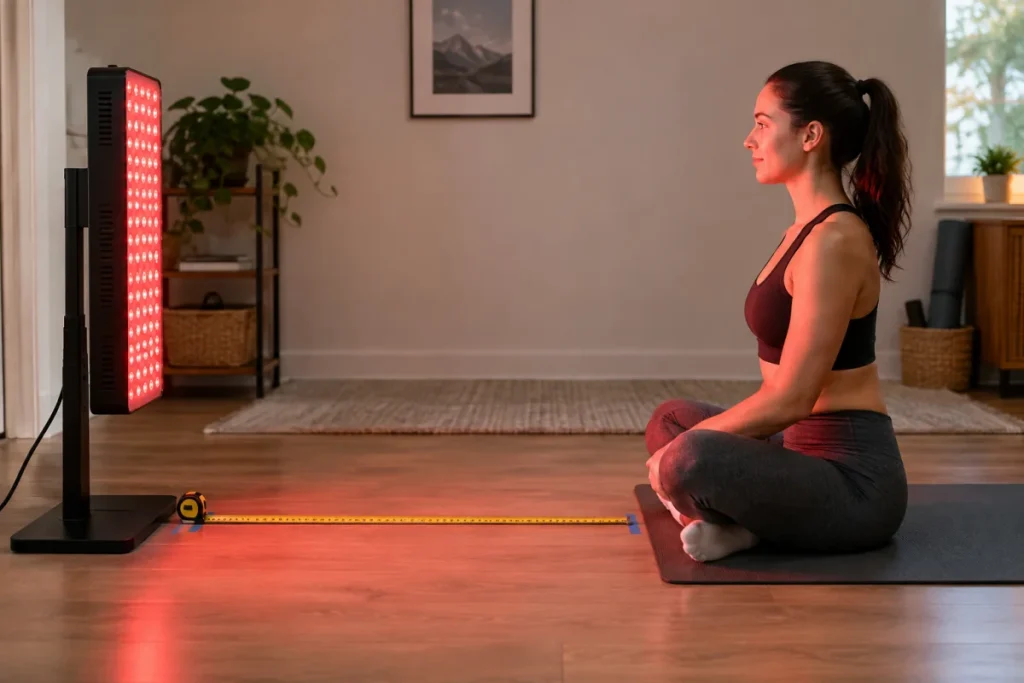
This is the practical home-use zone for many panels because it balances intensity and coverage. It gives the light some room to blend across the body while keeping sessions reasonably short. If you are building a routine around the face, torso, legs, or post-workout relaxation, this band is usually the easiest place to begin.
A conservative starting point is 5 to 10 minutes per area at roughly 12 to 24 inches, a few days per week, while watching for skin or eye discomfort and adjusting from there. More time is not automatically more sophisticated; sometimes it is just more time.
Farther range: about 24 to 36 inches
Farther spacing can make a larger panel feel more even, especially when you are trying to cover the front or back of the body without constantly repositioning. The trade-off is lower intensity, which means the same session length delivers less energy than it would closer to the panel.
This range works well when comfort and coverage matter more than squeezing the shortest possible session out of a device. It can also suit larger panels in a dedicated recovery corner, where stepping back a little gives the beam room to spread.
Long range: more than 36 inches
At this point, the session becomes more ambient unless the panel is large and powerful enough to support that distance. It may still feel pleasant as a light ritual, but dose estimates become harder to trust unless the manufacturer provides credible measurements at that distance.
How to adjust dose without overcomplicating it
Use one variable at a time. If you change distance, keep time the same for a week. If you change time, keep distance the same. If you change both every session, you are not dialing in a routine; you are shaking the Etch A Sketch.
- For a gentler start: move farther away or reduce session length.
- For a more focused session: move slightly closer before adding a lot more time.
- For better coverage: step back, use a larger panel, or split the session into front and back positions.
- For consistency: mark your standing spot with a mat edge, stool position, or floor tape.
Panel size matters here. A small tabletop unit at 12 inches behaves differently from a large panel at the same distance because the illuminated area is different. If your main problem is that you keep rotating and shuffling to hit multiple body zones, a bigger coverage class may solve more than another five minutes of session time. The site’s panel size guide is a good next read if distance is turning into a coverage problem.
Be careful with irradiance claims
Irradiance numbers are useful, but they are not always comparable across brands. Listings may report measurements at different distances, with different meters, under different assumptions, and sometimes without enough detail to reproduce the number. A panel claiming a high irradiance value at 6 inches is not automatically better than a lower-looking panel measured at 12 or 18 inches.
When reading specs, look for three things: the distance used for the measurement, whether the number applies to the center of the beam or a broader area, and whether the brand explains its method. The goal is not to become a lab technician. It is to avoid treating every published number as if it were measured in the same room, with the same tool, by the same person.
For example, a specs page such as the Mito Red Light MitoPRO 750X entry is most useful when you read its stated fields together: coverage class, listed wavelengths, mounting options, dimensions, and irradiance reporting. A single number rarely tells the whole ownership story.
A simple setup process
Step 1: Pick the body area
Decide whether you are treating the session as face-focused, torso-focused, leg-focused, or general relaxation. Smaller areas tolerate closer, shorter sessions more easily. Larger areas benefit from stepping back or using a bigger panel so the light does not land like a spotlight.
Step 2: Choose a starting distance
Use 12 to 24 inches as a sensible default unless the manufacturer gives a different instruction. For face sessions, many users prefer a comfortable seated setup with the panel stable and the eyes protected according to the device instructions. For body sessions, standing or sitting at a fixed distance is easier to repeat than holding a handheld position by memory.
Step 3: Set a modest time
Start with 5 to 10 minutes per area. If you are doing front and back body sessions, that means the total routine can double quickly, so keep it realistic. A plan that takes 40 minutes tends to become decorative wellness furniture by week three.
Step 4: Track only what changes decisions
You do not need a spreadsheet unless you enjoy spreadsheets. Note distance, session length, body area, and frequency. Also note discomfort, warmth, skin irritation, headache, eye strain, or anything else that tells you to back off or reassess. The useful question is simple: can you repeat this comfortably?
Step 5: Adjust slowly
After one to two weeks, change one lever. Add a few minutes, move a few inches closer, or increase weekly frequency. Do not max out all three at once. If the routine is intended to support recovery, skincare, or winding down, the habit matters as much as the arithmetic.
Common mistakes that throw off dose
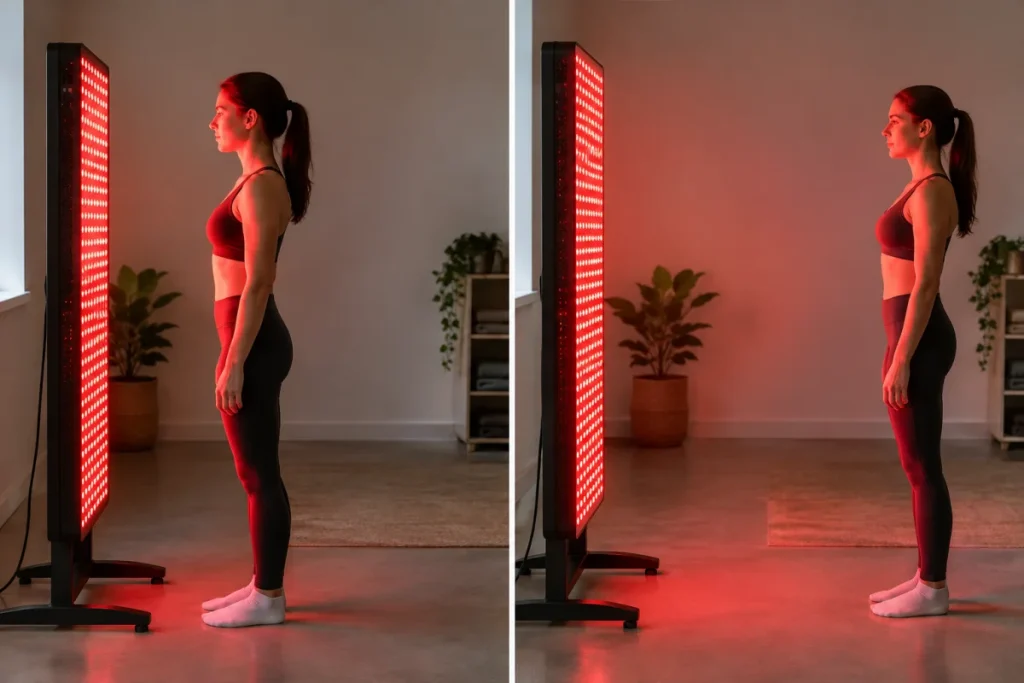
- Using the same time for every panel: a compact tabletop unit and a large panel do not provide the same coverage experience.
- Standing too close to a large panel: the center may get plenty of exposure while the outer body receives less than expected.
- Ignoring angles: turning sideways, slouching, or sitting off-center changes what actually receives light.
- Chasing warmth: warmth is not a reliable dose meter. Near-infrared can be invisible, and visible brightness is not the same as measured energy at skin.
- Trusting unlabeled irradiance: a number without distance and method is hard to use responsibly.
Questions people ask
Is closer always better?
No. Closer usually increases intensity, but it narrows coverage and can make the session less comfortable. For larger body areas, a little more distance often creates a more usable routine.
Can I calculate an exact dose at home?
You can estimate dose if you have credible irradiance information at your actual distance, but most home users should treat the result as approximate. Beam shape, distance, body angle, and measurement method all affect the real exposure.
How often should I use the same dose?
Frequency is part of dose planning because weekly exposure adds up. If you are still deciding whether to use a panel daily, every other day, or a few times per week, read the site’s guide to how often to use a red light therapy panel before adding more minutes.
Why it matters
Distance and dose are what turn a red light panel from an expensive glowing rectangle into a routine you can understand. Start in the middle range, use modest session times, read irradiance claims with a raised eyebrow, and adjust one variable at a time. The best setup is not the most intense one on paper; it is the one you can repeat comfortably, with enough coverage to match the reason you bought the panel in the first place.