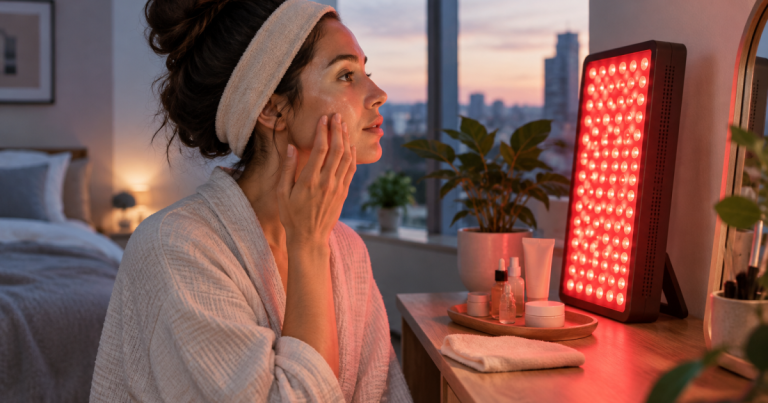
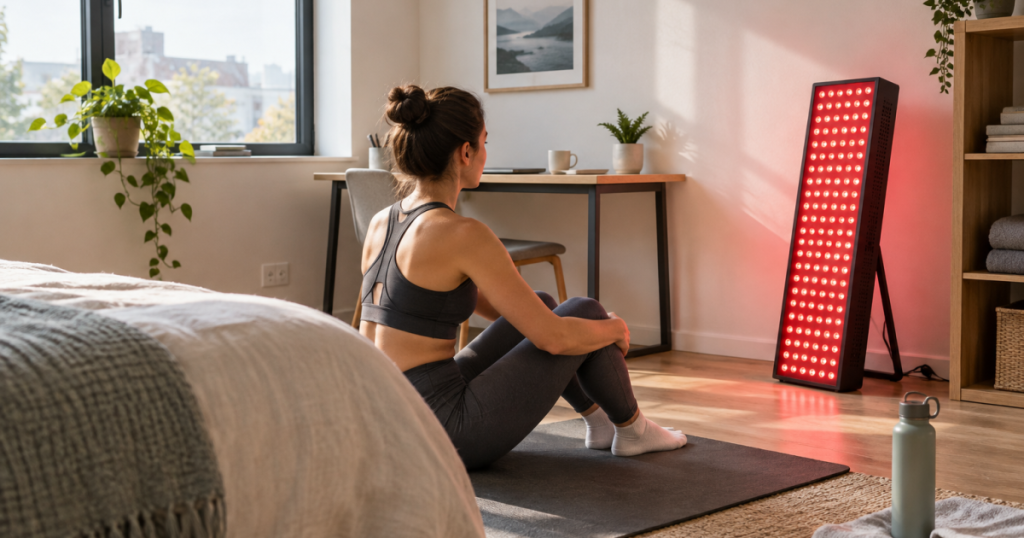
Once a panel stops feeling new, the real question changes from “how do I start?” to “what can I repeat without turning this into a chore?” The right red light therapy panel frequency is usually the one that gives each body area consistent exposure, leaves room for rest days, and fits the room where the panel actually lives.
A maintenance routine is not a competition to accumulate the most minutes under LEDs. It is a simple pattern you can follow while keeping distance, timing, comfort, and expectations steady.
Health-related decisions such as using a panel for an injury, skin condition, eye condition, or medication-related light sensitivity should be handled by a qualified healthcare professional in line with applicable medical guidance, product safety instructions, and local care standards.
The short version
For an ongoing maintenance routine, many home users do best with 3 to 5 sessions per week for each target area, rather than automatically using a panel every day. Session length and distance should come from the panel’s manual first; if the brand gives a range, start conservatively, keep the distance consistent, and adjust only after you know the routine is comfortable.
- Use 3 to 5 days per week as a sensible maintenance range for most non-medical home routines.
- Build in 1 to 2 rest days per week, especially if you are treating the same area repeatedly.
- Rotate body areas when using a larger panel instead of stacking long sessions on one area.
- Keep session distance and timing consistent before changing either variable.
- Stop thinking of heat, redness, or intensity as proof that the session is “working.” A repeatable routine should feel controlled, not aggressive.
Why maintenance is different from getting started
The first few weeks with a red light panel are often about learning the basics: where to stand, how far away to sit, how bright the light feels, and whether the routine belongs in the morning, after training, or near your evening wind-down. Maintenance is calmer. You are no longer trying to test every possible use case; you are choosing the smallest schedule that still feels worthwhile and sustainable.
This is also where “more” can become counterproductive. In photobiomodulation discussions, dosing is often described as having a useful range rather than a simple more-is-better curve. That does not mean a home user needs to calculate a clinical dose from scratch, but it does mean daily long sessions are not automatically superior to a focused 3 to 5 day rhythm.
Manufacturer recommendations vary because panels differ in size, wavelength mix, output reporting, beam angle, and suggested distance. Some brands publish session ranges by body area; others give broader setup guidance. Those numbers are not always measured or reported in identical ways, so it is smarter to follow your own panel’s instructions than to copy a routine from a different device.
A workable weekly rhythm
A good maintenance rhythm starts with the area you care about most. For a face and neck routine, that might mean shorter, more targeted sessions several days per week. For a post-workout routine, it might mean rotating legs, back, and upper body across the week. For a relaxation ritual, the win may simply be making the session easy enough that you do it consistently.
- Simple maintenance pattern: 3 sessions per week, such as Monday, Wednesday, and Friday. This works well when you want a low-friction habit and do not want the panel to dominate your schedule.
- More engaged pattern: 4 to 5 sessions per week, with at least one rest day and some body area rotation. This suits users who already have a stable routine and know their preferred distance and session length.
- High-friction warning sign: if the schedule requires moving furniture, changing clothes twice, or negotiating with everyone in the house, it is probably too complicated for maintenance.
One clean example is a four-day rhythm: front body on Monday, back body or legs on Tuesday, rest on Wednesday, target area on Thursday, and an optional shorter session on Saturday. The exact days matter less than the pattern: repeated exposure, consistent setup, and recovery space between sessions.
Distance and session length belong together
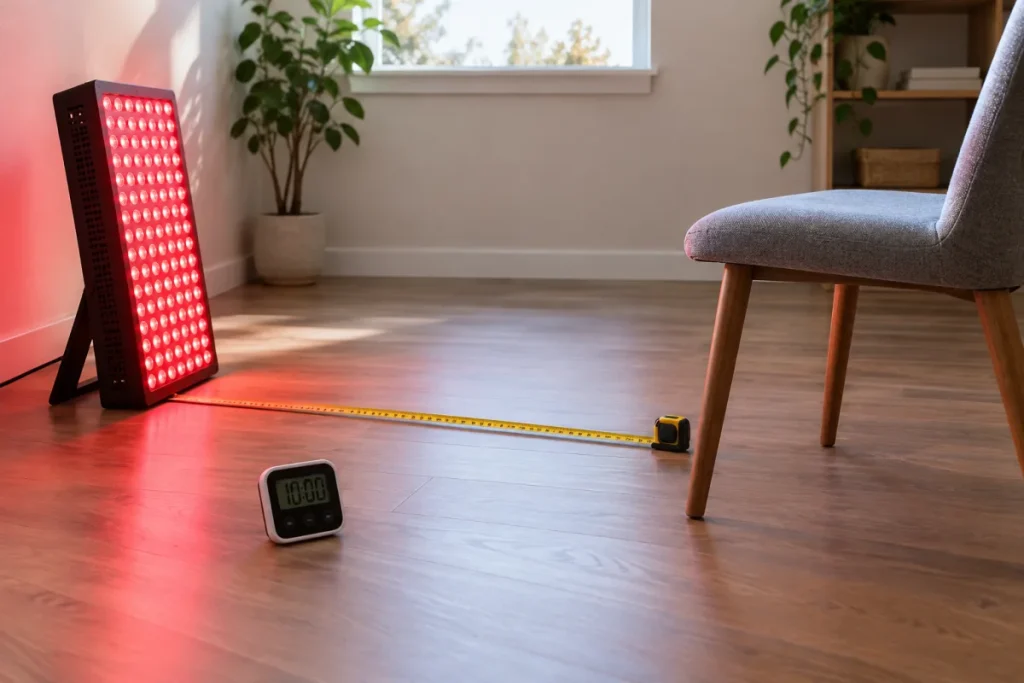
Frequency is only one part of the routine. A 10-minute session close to a high-output panel is not the same experience as 10 minutes farther away from a smaller unit. Distance and session length should be treated as a pair, not two separate dials you turn randomly.
Use the brand’s stated distance range as the starting point. If the manual offers a closer and farther option, choose a comfortable middle ground first. Then keep that distance steady for at least a couple of weeks before deciding whether your maintenance routine needs adjustment.
A tape mark on the floor, a dedicated stool, or a fixed wall-mounted location can do more for consistency than another spreadsheet. The less you have to rethink your setup, the more likely the routine becomes automatic.
Rotate areas instead of piling on minutes
Body area rotation is the quiet trick that makes maintenance routines more realistic. If you use a half-body or full-body panel, you may be tempted to do front, back, face, legs, and a “bonus” target area every time. That can turn a 12-minute habit into a 45-minute production.
Instead, decide what counts as one session for you. For example, one session might be front torso and face, or back and shoulders, or legs after training. Larger panels can reduce the number of positions you need, while smaller panels may require more targeted placement. Neither approach is automatically better; the better setup is the one you can repeat without rushing.
If you are comparing panel formats for routine-building, product pages such as the Mito Red Light MitoPRO 750X and Hooga Ultra 750 are useful because they keep the focus on coverage class, mounting options, wavelengths, and reported specs rather than vague “best panel” language.
When daily use makes sense, and when it does not
Daily use is not automatically wrong. Some users prefer short daily sessions because they attach the habit to something already fixed, like brushing teeth, mobility work, or a post-shower skincare routine. The key is that daily use should usually mean shorter, controlled sessions rather than an excuse to keep adding time.
Daily use is less compelling when it creates friction, encourages you to ignore the manual, or makes rest days feel like failure. A panel should support your routine, not become another wellness chore you have to “catch up” on.
If your session leaves your skin feeling irritated, your eyes uncomfortable, or your schedule stressed, reduce frequency, shorten the session, increase distance within the manufacturer’s guidance, or pause and reassess. Maintenance should feel boring in the best possible way: predictable, calm, and easy to repeat.
Room setup changes how often you will actually use it
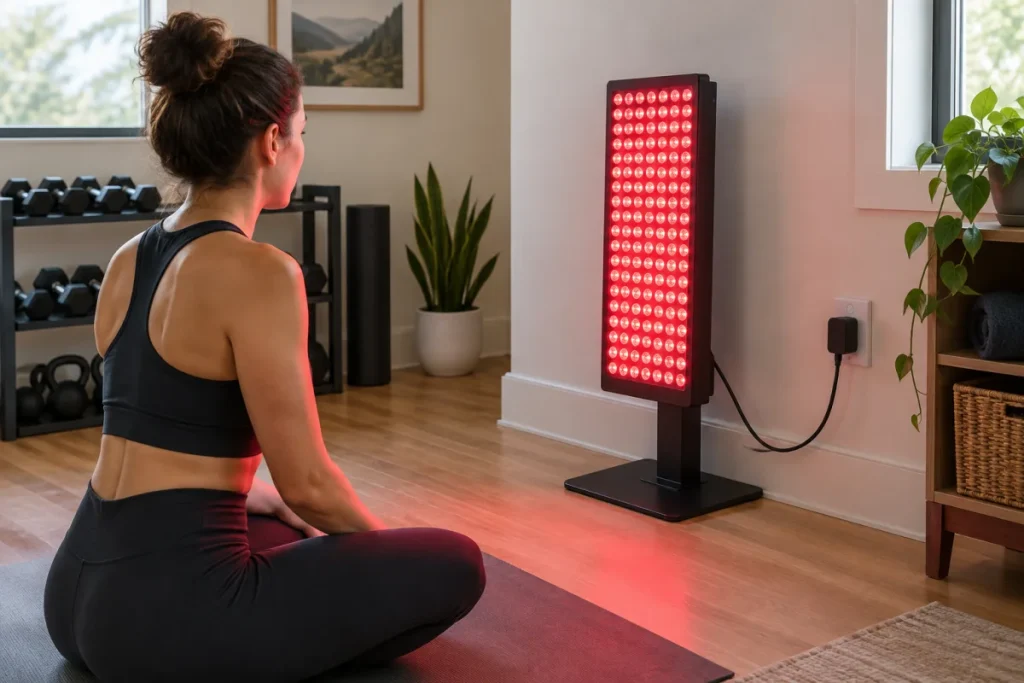
The best schedule on paper often fails because the panel is awkward to access. If your light is packed in a closet, blocked by a desk chair, or mounted where standing feels uncomfortable, the habit will slip. A good setup makes the next session obvious.
For a bedroom or wind-down routine, think about cable routing, eye comfort, timer access, and whether the panel height matches the area you plan to treat. If you are considering an overhead or bed-adjacent arrangement, read the safety-focused guide to positioning a red light therapy panel over a bed before treating convenience as the only design goal.
For a home gym routine, place the panel where it naturally follows training rather than competing with it. Ten consistent minutes after a workout is more useful than an elaborate routine you only complete once a month.
Common mistakes that derail maintenance
- Changing too many variables at once: If you increase frequency, session length, and closeness in the same week, you will not know which change matters.
- Copying another person’s routine exactly: Their panel, distance, body area, schedule, and tolerance may be different from yours.
- Using brightness as a scoreboard: A visually intense session is not automatically a better session, especially with near-infrared wavelengths that are less visible.
- Skipping the manual: The brand’s distance and session guidance is the most relevant starting point for that device.
- Making every session full-body: Targeted rotation is often easier to sustain than trying to cover everything every time.
Things readers ask
What is a good red light therapy panel frequency for long-term use?
A sensible long-term range is 3 to 5 sessions per week per target area, with 1 to 2 rest days built in. Some people prefer short daily sessions, but daily use is not required for a credible maintenance routine.
Should I use red light therapy before or after workouts?
Both patterns are common in home routines, but the best choice is usually the one you can repeat. If the panel is part of recovery, many users place it after training because it fits naturally with stretching, showering, or winding down.
Can I use a panel on my face and body on the same day?
Yes, many users rotate face and body areas on the same day, provided they follow the panel’s instructions for distance, timing, and eye comfort. The practical limit is usually consistency: do not make the session so long that you stop doing it.
How long should I wait before changing my routine?
Give a maintenance routine at least a couple of weeks before changing it, unless it feels uncomfortable. Stable timing, distance, and frequency make it easier to judge whether the habit is realistic.
Practical takeaway
Use your red light therapy panel often enough to create consistency, not so often that the routine becomes fragile. For most maintenance routines, 3 to 5 sessions per week, a fixed distance, a timer, and simple body area rotation are enough structure to keep the habit useful without turning it into a project.
The best routine is the one you can repeat on an ordinary week: not the perfect week, not the most motivated week, and definitely not the week when you decide your wellness corner needs the operational complexity of a small airport.