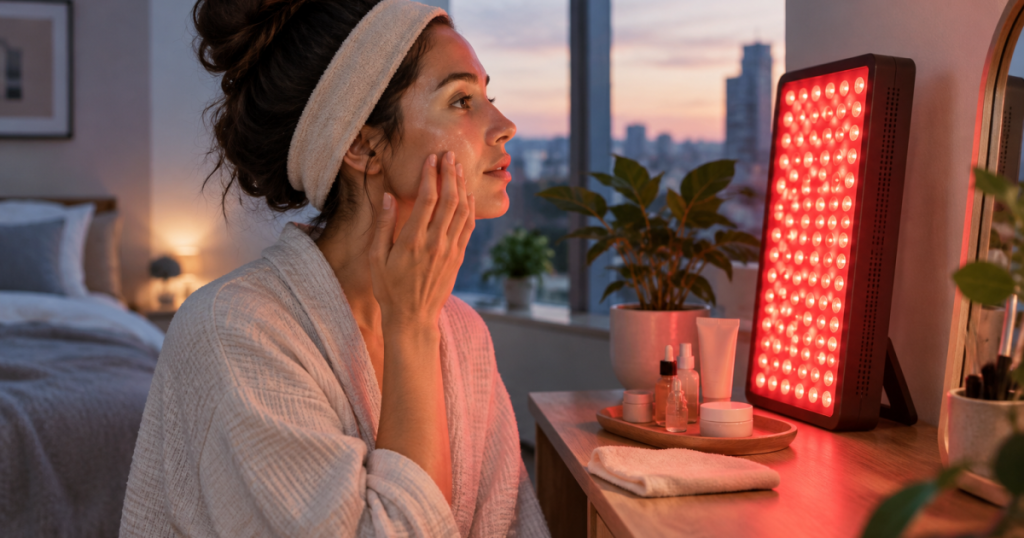
Skincare makes red light sessions feel more intentional, but it also creates the one timing question that trips people up: does the panel go before or after the products? A good red light skincare routine is mostly about sequencing: cleanse first, use the panel on clean dry skin, then apply leave-on products in the order your skin already tolerates.
Diagnosis or treatment of skin conditions, photosensitivity, or medication-related light sensitivity should be handled by a qualified healthcare professional in line with applicable clinical standards and local safety requirements.
The clean-skin rule
Use a red light therapy panel after cleansing and before serums, moisturizer, oils, sunscreen, and makeup. That sequence gives the light the simplest path to skin, avoids warming layers of product against your face, and keeps the session easy to repeat.
The strongest routine is not the most elaborate one. It is the one you can do without negotiating with six bottles, a timer, and a mirror every night. Think of the panel as the bridge between cleansing and treatment skincare: first remove the day, then run the session, then apply products.
Most home panel routines are based on manufacturer instructions and user practice rather than a universal skincare protocol. Published research uses controlled conditions, and product-layer interactions are not usually the point of those studies. So the sensible home approach is simple: keep the session clean, consistent, and separate from strong actives when your skin is easily irritated.
The best order: cleanser, panel, products
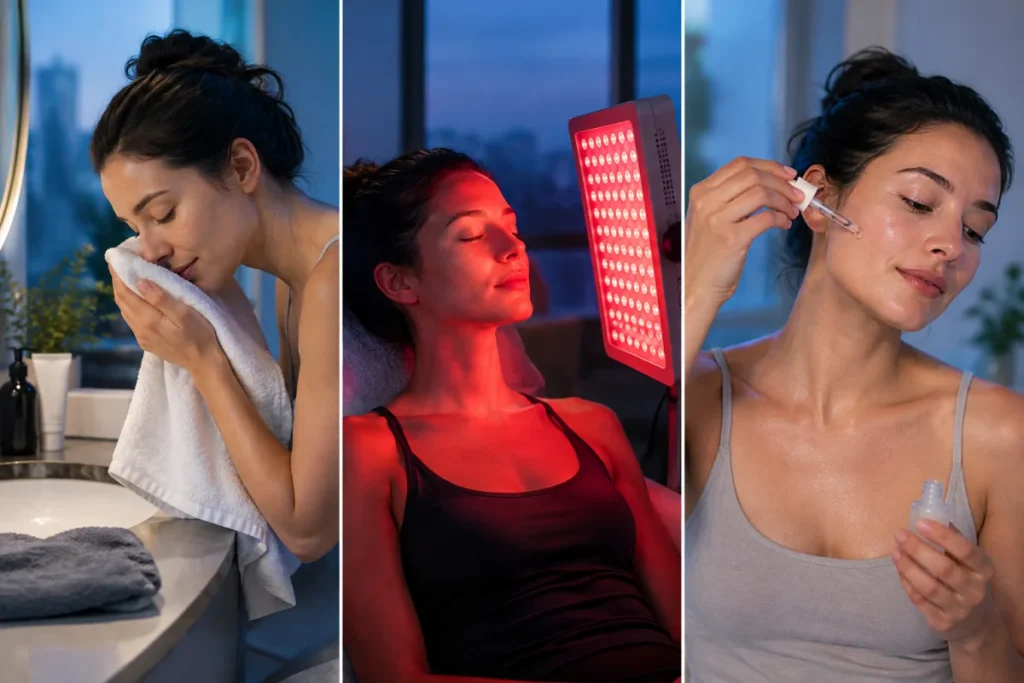
For most people, this is the cleanest sequence to follow:
- Step 1 — Cleanser: Wash off makeup, sunscreen, sweat, and residue. Pat skin dry rather than leaving it wet or slick.
- Step 2 — Red/NIR session: Use the red light or red plus near-infrared setting according to the panel maker’s instructions. Keep your distance, timing, and eye guidance consistent.
- Step 3 — Lightweight serums: Apply hydrating or calming serums after the session. Products with humectants such as hyaluronic acid fit well here if your skin already likes them.
- Step 4 — Moisturizer: Seal in hydration after serums. A bland moisturizer is often the easiest partner for a routine you want to repeat.
- Step 5 — Retinoids or acids: Use retinoids, exfoliating acids, or benzoyl peroxide after the light session, not before. If your skin is reactive, keep these on alternate nights from panel use until you understand your tolerance.
- Step 6 — Sunscreen: In the morning, apply sunscreen after the panel and after moisturizer. Do not run a panel session over sunscreen unless the device instructions specifically support that use.
- Step 7 — Makeup: Makeup comes last. If you want a session later in the day, remove makeup first rather than shining light through foundation or powder.
That list is deliberately boring in the best way. It removes guesswork and makes the routine feel less like a lab protocol and more like a clean, repeatable ritual.
Morning timing versus evening timing
A morning session can work well if you want your panel to sit near a shower, vanity, or quick getting-ready area. Cleanse, use the panel, apply moisturizer, then finish with sunscreen. If makeup is part of the day, it belongs after sunscreen has settled.
An evening session is usually easier for people using retinoids or exfoliating acids because those products are already commonly placed at night. The order still stays the same: cleanse, panel, then active skincare. If a retinoid makes your skin dry, tight, or stingy, do not interpret that as a sign to add more wellness steps. Reduce complexity and let your skin barrier catch up.
Post-workout timing is a third useful option. If your face is sweaty, cleanse or rinse first. A red or near-infrared session over sweat, sunscreen, or gym residue may be less comfortable, and comfort is one of the quiet reasons routines either stick or disappear.
Where retinoids, acids, and vitamin C fit
Retinoids and exfoliating acids are the products most worth separating from the panel step. Not because a panel automatically makes them dangerous, but because strong actives can already increase dryness, peeling, or sensitivity for some users. Putting them on after the light session gives you cleaner timing and makes irritation easier to interpret.
Vitamin C is more flexible. Many people use it in the morning under sunscreen, which means it can sit after a morning panel session. If your vitamin C serum stings on freshly cleansed skin, do not make the panel the scapegoat too quickly; the formula, pH, and your skin barrier may matter more than the timing. Keep notes for a week if you are adjusting several products at once.
Hydrating serums and barrier-supporting moisturizers are the least complicated companions. They do not need to be on the skin during the session to be useful. Apply them afterward, when the light step is finished and your routine can shift back into skincare mode.
Panel size changes the routine more than people expect
A face-only routine is quick because the panel, mirror, and products can live in the same small zone. A larger panel can make the session feel more like recovery time: face, neck, chest, shoulders, or upper body depending on the device and setup. That can be great, but it also means you may need a clearer pre-session plan: remove sunscreen from exposed areas, tie hair back, and decide whether this is a skincare session or a broader wind-down habit.
Half-body panels such as the Mito Red Light MitoPRO 750X are useful reference points when you are thinking beyond the face but not building a full-height recovery wall. The exact routine still depends on manufacturer instructions, room layout, and the areas you expose, but the sequencing principle does not change: clean skin before light, leave-on products after.
If the panel lives in a bedroom or small vanity corner, placement matters as much as skincare theory. You want the cleanser, towel, eye protection, timer, and moisturizer close enough that the routine has momentum. For tight layouts, the setup ideas in fitting a red light therapy panel into a studio apartment are useful even if your space is simply compact rather than tiny.
Mistakes that make timing harder
- Using the panel over makeup: Foundation and powder add an unnecessary layer between the panel and skin. Remove them first.
- Leaving sunscreen on for an indoor session: Sunscreen belongs after a morning session, not before it, unless your device instructions say otherwise.
- Stacking every active on panel nights: Retinoid, acid, and red light all in one ambitious evening may be too much for reactive skin. Simplify first, then build.
- Changing distance and timing constantly: If you move the panel closer one day and double the session the next, you will not know what your skin is responding to.
- Treating warmth as proof of better results: Comfortable, repeatable sessions are more useful than chasing intensity. Follow the device guidance rather than inventing a stronger protocol.
A simple weekly rhythm
Start with the minimum routine that feels easy: cleanse, panel, moisturizer. Keep that steady for a week or two before adding strong actives around it. If your skin already tolerates retinoids or acids, place them after the session on the nights you normally use them. If your skin is new to those products, avoid starting a new retinoid and a new panel routine on the same night; it makes troubleshooting almost impossible.
For a clean evening rhythm, try three to five planned panel sessions per week if that fits your device instructions and your schedule. On retinoid nights, panel first. On exfoliation nights, panel first or skip the panel if your skin feels stressed. On recovery nights, use the panel followed by a plain moisturizer and call it done. There is a certain elegance in a routine that knows when to stop.
Helpful follow-ups
Can I apply serum before using a red light panel?
For most home routines, apply serum after the panel. A serum underneath the session is usually unnecessary and can make timing, comfort, and irritation harder to read.
Should I use a panel before or after sunscreen?
Use the panel before sunscreen. In a morning routine, cleanse, run the session, apply skincare, then finish with sunscreen before daylight exposure.
Can I use red light and near-infrared around the eyes?
Follow the panel maker’s eye protection instructions, especially when near-infrared is involved because it is not visible in the same way red light is. Do not stare directly into bright LEDs.
What to do next
The most reliable red light skincare routine is not complicated: clean dry skin, panel session, then skincare. Once that order is automatic, refine the details around your actual life: morning sunscreen, evening retinoids, workout showers, and the panel size you can use without friction.
If you are still deciding whether a larger setup would make your routine easier or just take up more space, compare coverage formats in full-body red light therapy panels for at-home routines. The best panel for skincare is the one you can place, time, and repeat without turning your bathroom counter into mission control.