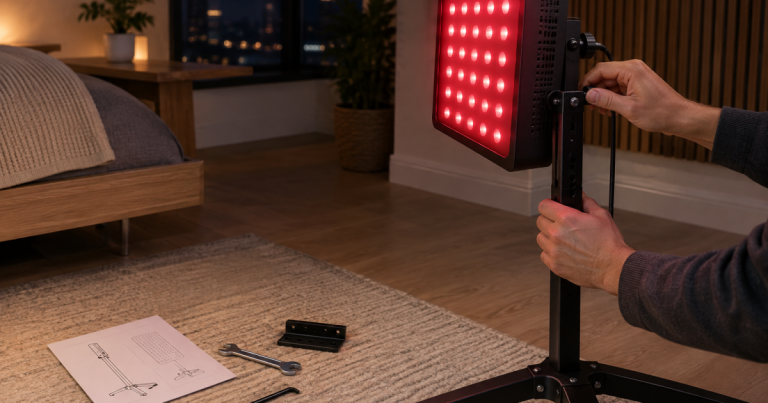
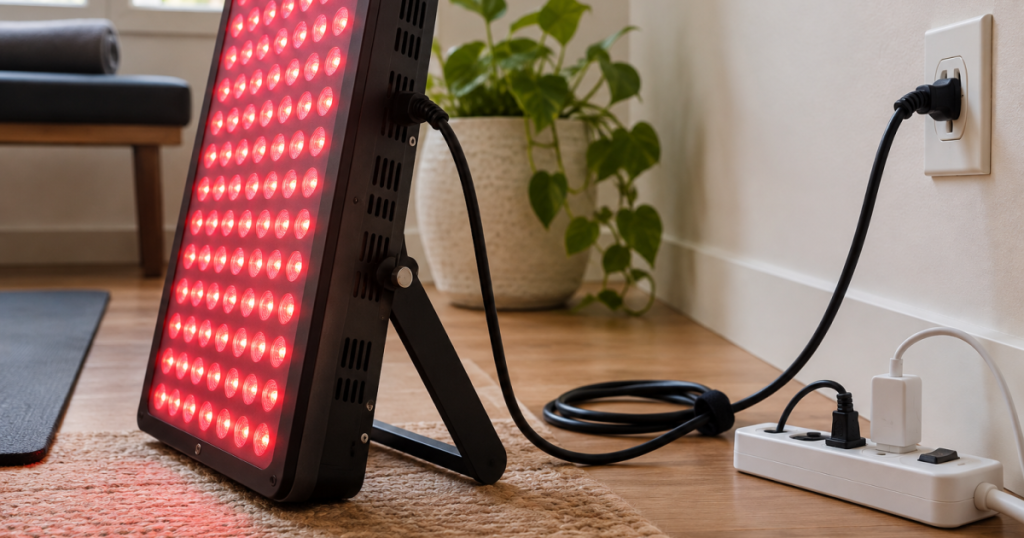
A red light panel extension cord can seem like the final detail that makes a home setup work: the panel reaches the mat, the stand clears the wall, and the session feels less like rearranging furniture. The sensible answer is not simply yes or no. It depends on the panel’s power draw, the cord or strip rating, the outlet, and the manufacturer’s instructions.
Any new outlet installation, outlet repair, or circuit work should be carried out by a qualified electrician to comply with local electrical codes and recognized safety standards.
The short version
Many red light therapy panels can be used with a properly rated extension cord, power strip, or surge protector, but only when the manufacturer allows it and the accessory is rated for the electrical load. Do not daisy-chain strips, do not run cords under rugs, and do not use damaged, loose, hot, or lightweight cords with a high-draw panel.
- Check the panel’s listed wattage or input rating before choosing a cord or strip.
- Convert watts to amps by dividing watts by 120 for a standard household circuit.
- Use a cord, power strip, or surge protector rated above the panel’s load.
- Keep the connection visible, dry, and ventilated.
- Use the wall outlet directly when the manufacturer requires it or when the setup feels marginal.
Why panel power matters more than cord length
Red light therapy panels are not all the same electrically. A compact tabletop panel and a large full-body panel may both be used for similar wellness routines, but they can place very different demands on an outlet. The practical question is not whether the accessory is called an extension cord or a power strip. The question is whether it is built to carry the panel’s actual load safely for the length of a session.
Start with the label on the panel or power adapter. Look for watts, amps, voltage, or input current. If the panel lists watts, the basic load estimate on a 120-volt circuit is simple: watts divided by 120 equals amps. A device drawing 300 watts would be about 2.5 amps. A device drawing 600 watts would be about 5 amps. This is not a performance claim about light output; it is only an electrical load calculation.
That distinction matters because watts do not tell you how much useful light reaches your body. If you are comparing panel performance rather than outlet load, it helps to separate electrical consumption from optical output. Our explainer on how watts, LED count, and irradiance differ covers that comparison in more detail.
Extension cord, power strip, or surge protector?
These accessories solve different problems, even though they often live in the same drawer.
Extension cords
An extension cord is mainly for distance. It lets you place a panel where the session makes sense: beside a yoga mat, near a recovery bench, or behind a sturdy chair. For a red light setup, the safer choice is usually a heavy-duty cord that is short enough for the room layout, rated for indoor use, and rated for the panel’s amp load. Very thin, very long, or visibly worn cords are a poor match for equipment you plan to use repeatedly.
Power strips
A power strip creates more outlets, but it does not create more circuit capacity. If the panel, a treadmill, a fan, and a heater are all on the same strip or wall circuit, the total load matters. A strip with several empty sockets can still be the wrong choice if its rating is too low or if it is already feeding other high-draw devices.
Surge protectors
A surge protector is a power strip with components designed to help reduce voltage spikes. It can be a reasonable choice for protecting electronics, but it should still be properly rated and listed by a nationally recognized testing laboratory such as UL or ETL. Surge protection is not a substitute for load capacity, good cord condition, or manufacturer approval.
A simple load check before you plug in
Use this quick sequence before making an extension cord or power strip part of your routine:
- Read the panel rating. Use the wattage or input current listed on the panel, adapter, or manual. If the manual says to plug directly into a wall outlet, follow that instruction.
- Calculate the approximate amps. On a 120-volt circuit, divide watts by 120. This helps you compare the panel to the accessory rating.
- Check the cord or strip rating. Look for a label showing amps, watts, volts, or wire gauge. The accessory should be rated comfortably above the load you plan to use.
- Add the other devices. A panel may be fine alone but not fine on the same strip as a space heater, dehumidifier, or powered exercise equipment.
- Watch for heat or looseness. A plug, cord, strip, or outlet that feels hot, smells unusual, sparks, buzzes, or fits loosely should not be used.
For panel owners, this is one of those unglamorous setup details that pays off every week. A clean cord path means fewer skipped sessions, fewer awkward stand positions, and less temptation to balance an expensive panel somewhere it does not belong.
Where larger panels change the decision
The bigger the panel, the more careful the accessory choice becomes. Larger panels may have higher electrical draw, heavier power cords, and less tolerance for improvised placement. A half-body panel on a stand may only need a small shift in outlet access, while a full-body arrangement can create a more permanent recovery corner with cable management, floor clearance, and eye-line comfort to think through.
When comparing panels, published specs can help you plan the room before the box arrives. For example, a page like the Mito Red Light MitoPRO 750X entry is useful not because one spec answers every setup question, but because dimensions, weight class, mounting context, and power-related details all affect where the panel will realistically live.
If a panel is going into a dedicated workout area, avoid routing cords across walking paths or under rubber flooring. If it is going into a bedroom or office, think about whether the cord will be unplugged after each session or left in place. Temporary use and permanent-looking use should be treated differently: the more often a cord stays connected, the more important strain relief, visibility, and trip prevention become.
What not to do
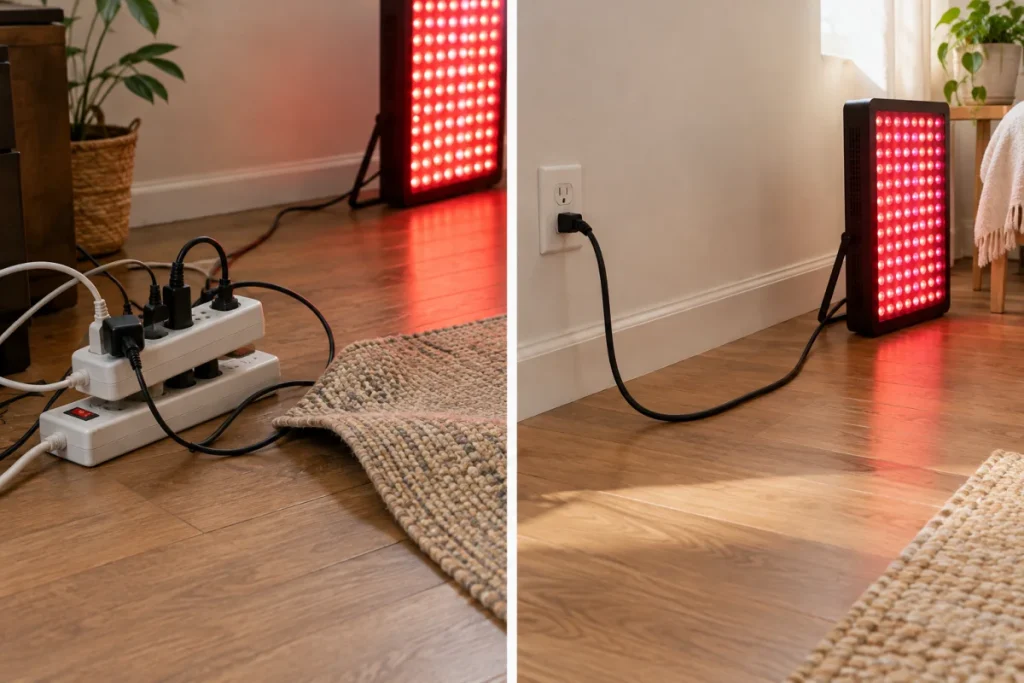
Most problems come from stacking small compromises. One questionable adapter, one overloaded strip, and one cord hidden under a rug can turn a tidy wellness corner into a poor electrical setup.
- Do not plug one power strip into another power strip.
- Do not use an extension cord that is warm during normal use.
- Do not hide cords under rugs, mats, bedding, or heavy furniture.
- Do not use outdoor, garage, or workshop cords indoors if they are damaged, dirty, wet, or poorly matched to the setup.
- Do not assume a surge protector can handle any device just because it has multiple outlets.
- Do not bypass a manufacturer warning that says wall outlet only.
Small accessories that make the setup safer and easier
Electrical accessories are only part of the picture. A stable stand, thoughtful panel height, and a clear session zone can reduce how much cord length you need in the first place. Sometimes the best cable solution is moving the panel closer to the outlet and adjusting the seating position, rather than stretching power across the room.
Protective eyewear also belongs in the setup conversation. Cord placement gets the panel in the right spot; eye comfort and exposure control help make the routine feel sustainable. If your face is near the beam or you use near-infrared modes, read our guide to eye protection for red light therapy panels before settling into a repeatable routine.
Common questions
Is a heavy-duty extension cord always safe for a red light therapy panel?
No. Heavy-duty is helpful, but it is not a blanket guarantee. The cord still needs to be rated for the panel’s load, used in good condition, kept visible and ventilated, and allowed by the panel manufacturer.
Is a surge protector better than a basic power strip?
For electronics protection, a properly rated surge protector is usually preferable to a basic strip. For electrical capacity, the same rule applies to both: the rating must exceed the total load connected to it.
Can one outlet handle a panel and other wellness gear?
Sometimes, but add the loads rather than guessing. Fans, heaters, treadmills, massage tools, and panels can share a space without all belonging on the same strip or circuit at the same time.
Should I unplug the panel after every session?
If the manufacturer recommends unplugging, follow that guidance. Even when it is not required, unplugging can be a tidy habit for setups that are moved often or used in multipurpose rooms.
The practical takeaway
Using an extension cord, power strip, or surge protector with a red light therapy panel can be reasonable when the accessory is properly rated, the total load is understood, and the manufacturer does not prohibit it. The safest setup is usually the least dramatic one: a sound outlet, a short and appropriately rated cord if needed, no daisy chaining, no hidden heat traps, and a room layout that lets the panel sit securely.
That may sound less exciting than wavelengths and irradiance charts, but it is part of what makes a home light routine feel polished. The right cord decision turns the panel from a device you have to negotiate with into a piece of wellness gear that simply fits the room.