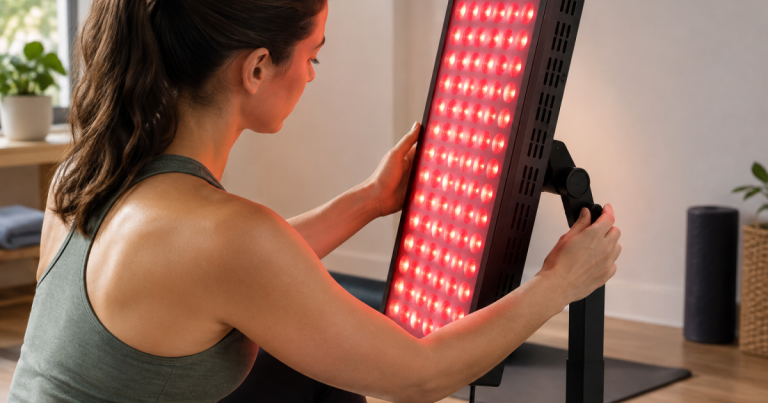
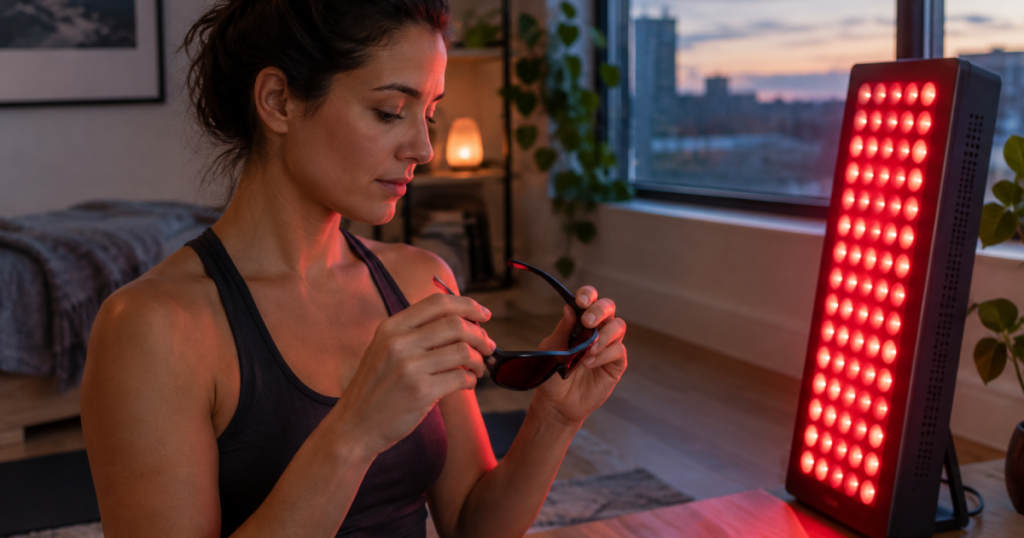
Face-facing panel sessions create a simple but important decision: red light therapy eye protection is usually worth using when your eyes are in or near the beam, especially if the panel also emits near-infrared light. Visible red light can feel bright and uncomfortable; near-infrared is trickier because you may not perceive it as glare even when your eyes are exposed. A calm, conservative approach keeps the ritual usable without turning it into a medicalized procedure.
Evaluation of eye pain, diagnosed eye disease, recent eye surgery, or medication-related light sensitivity should be handled by a qualified eye care professional in line with applicable clinical standards and safety requirements.
The short version
- Wear protective goggles when using a red and near-infrared panel close to your face or when your eyes face the LEDs directly.
- Closed eyes reduce brightness discomfort, but they should not be treated as universal protection, particularly with near-infrared modes.
- If your panel has separate red-only and NIR modes, the more cautious choice is to use goggles for NIR or combined red/NIR sessions near the face.
- Distance, angle, session length, and personal sensitivity all change the decision. A panel across the room is not the same exposure as a face-level session a short distance away.
- Choose eyewear that the maker describes as appropriate for red and near-infrared light, not just ordinary sunglasses.
Why eyes deserve a separate decision
Red light therapy panels are often discussed in terms of skin, muscle recovery, and routine-building, but the eyes sit in a different category of exposure. The cornea, lens, retina, eyelids, and tear film all interact with light differently than the skin on your shoulders or legs. Comfort is also a factor: a bright panel can make you squint, tense your face, or cut sessions short, which works against the point of a repeatable wellness habit.
Visible red light is easy to notice because it looks bright. Near-infrared light, often abbreviated as NIR, is outside normal human vision, so it does not create the same warning sensation. That does not automatically make a home panel dangerous, but it does mean that comfort alone is a poor exposure guide. If the beam is aimed at your face, relying only on whether it feels too bright is not the most careful strategy.
Panel specifications can also be difficult to compare. Brands may report wavelengths, irradiance, and recommended use distances differently. When you are comparing models, look at the listed wavelength profile and intended use rather than assuming every red panel behaves the same. For example, a spec page for the Mito Red Light MitoPRO 750X is useful because it gives you a structured place to check the panel’s published wavelength information before planning face-facing sessions.
A practical decision guide for goggles
There is no single rule that fits every panel, every distance, and every user. A better red light therapy eye protection decision uses five variables: panel mode, distance, face direction, personal sensitivity, and eyewear type.
By panel mode
- Red-only mode: If the panel emits visible red light only and you are not staring directly into it, eye exposure is generally less concerning than with NIR. Goggles are still sensible if the light feels intense, the panel is close, or you are treating your face.
- Near-infrared-only mode: Use goggles when the panel is aimed toward your face or eyes. Because NIR is not visible, you cannot use brightness as your cue.
- Combined red and near-infrared mode: Treat this as the default goggles scenario for face-level sessions, particularly when you are sitting or standing near the panel.
By distance
- Close sessions: The closer your eyes are to the emitting surface, the more conservative you should be. Follow the panel maker’s use instructions and wear protective eyewear when your face is near the beam.
- Moderate distance: Goggles are still a good idea if the panel faces your eyes. If the session is for the torso, legs, or back and your eyes are angled away, the decision may be more about comfort and exposure control.
- Farther placement: A panel placed farther away and not aimed at the face reduces direct eye exposure, but it does not turn a bright device into ambient mood lighting. Avoid staring at it.
By face direction
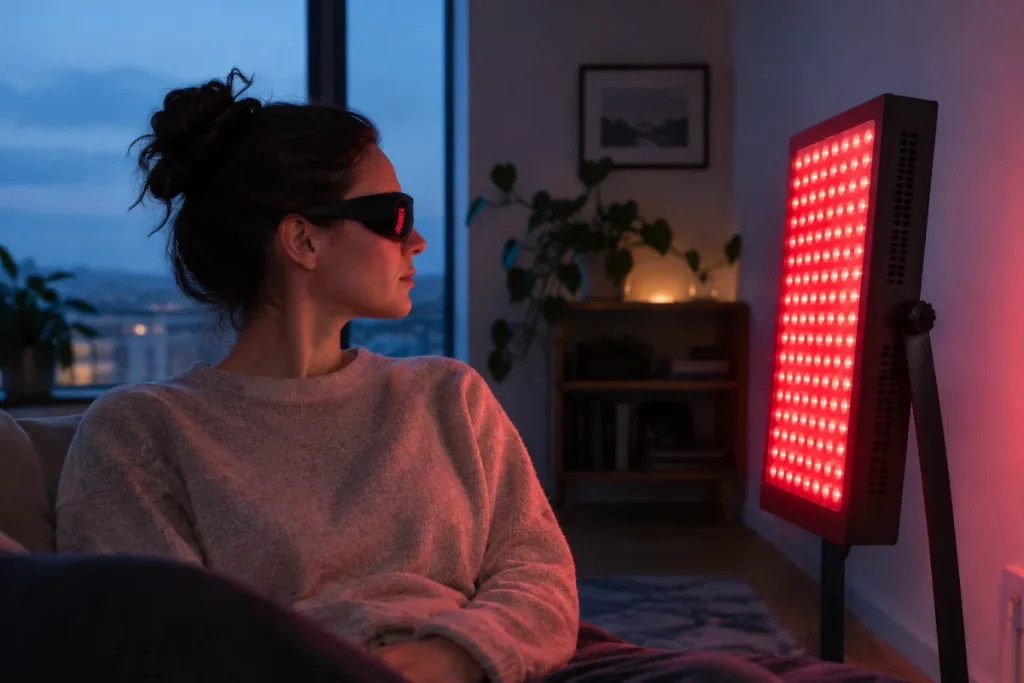
- Looking toward the LEDs: Wear goggles. This is the simplest and most defensible rule.
- Eyes closed but face forward: Closed eyelids can reduce visible brightness, but they are not a complete safety plan for every wavelength mix or intensity.
- Head turned away: This can lower direct exposure, but goggles remain useful if the panel is close, bright, or includes NIR.
By sensitivity
- Light-sensitive users: People who are prone to eye strain, headaches from bright light, or discomfort during LED exposure should use goggles and shorter, more comfortable sessions.
- Contact lens wearers: Contacts do not replace protective eyewear. If the light dries or irritates your eyes, pause the session and adjust your setup.
- Known eye conditions: Do not treat a wellness panel as a workaround for medical guidance. Get individualized advice before using bright face-facing light.
By eyewear type
- Opaque or blackout-style goggles: These block the viewing experience most completely and can be useful when the panel is close to the face.
- Red-tinted or filtered goggles: These may reduce glare while allowing some visibility, but check that the product is intended for the wavelengths your panel emits.
- Ordinary sunglasses: These are not a reliable substitute unless the manufacturer clearly states relevant red and near-infrared filtering performance.
How this changes common home routines
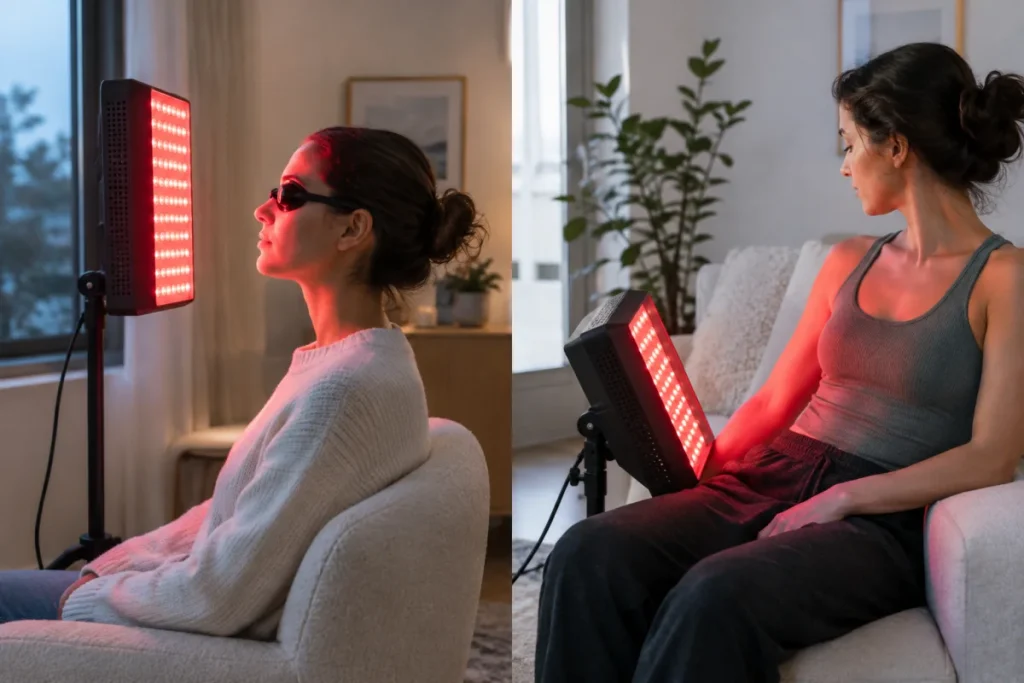
A face-only skincare session is the scenario where goggles make the most sense. The panel is usually closer, centered, and aimed directly toward the eyes. The practical adjustment is easy: put on appropriate eyewear, close your eyes if comfortable, and avoid trying to read, scroll, or watch the LEDs during the session. The less multitasking you build into a face-facing routine, the easier it is to keep exposure consistent.
For a half-body panel session, the decision depends on orientation. A half-body panel such as the Joovv Half-Max 3.0 may be used in routines where the beam reaches the chest, shoulders, neck, and face area depending on placement. If your eyes are in the beam, use goggles. If the session is focused on the back or lower body and your head is turned away, eyewear may be less central, though it can still make the experience more comfortable.
For post-workout or mobility routines, many people aim panels at the legs, hips, shoulders, or back while stretching or standing. In those cases, the most useful habit is spatial: set the panel height so it serves the target area without shining straight into your eyes. Good setup often reduces the need to negotiate with yourself each session.
What not to assume
Do not assume that every red light panel has the same eye-safety profile. A small desktop device, a half-body panel, and a large full-body setup can create very different exposure patterns in a room. Do not assume that a short session is automatically trivial if the panel is very close to the face. Do not assume that discomfort is the only signal worth respecting, because NIR exposure may not feel bright.
At the same time, there is no need to turn a home panel into a source of anxiety. The goal is a boringly repeatable safety habit: use the panel as directed, avoid staring into LEDs, wear eyewear when the face is exposed, and change the setup if it makes you squint or tense up. The most sustainable routine is usually the one that feels calm enough to repeat.
Skin routines add one more reason to be cautious
Eye protection is not the only face-session variable worth thinking through. People using panels for complexion-focused routines often care about heat, light exposure, pigmentation history, and how skin responds over time. If you are building a facial routine and monitoring dark spots or pigment changes, it is worth reading about whether red light panels can trigger melasma or dark spots. The eye decision and the skin decision are separate, but both benefit from slower setup changes and careful observation.
Follow-up concerns
Can I just close my eyes?
Closing your eyes is better than staring into a bright panel, but it should not be your only strategy for close, face-facing, NIR, or combined-mode sessions. Goggles give you a clearer margin because they do not depend on eyelid position, squinting, or moment-to-moment attention.
Should children or pets be near the panel?
Keep bright panels controlled and supervised. Children and pets may look directly at the LEDs without understanding the exposure, so it is better to keep them out of the beam during sessions.
Do goggles ruin the session?
No. Protective eyewear may slightly change the feel of a facial routine, but it usually makes the session more relaxing because you are not fighting glare. In practice, the best gear is the gear that helps you use the panel consistently and comfortably.
A steady rule for everyday use
For most home users, the simplest rule is this: wear goggles when a red light therapy panel is close to your face, aimed at your eyes, or running near-infrared light. You can be more flexible for body-focused sessions where the panel is not directed toward your face, but avoiding direct viewing remains sensible. That small habit protects the calm, intentional quality that makes a home light routine appealing in the first place.