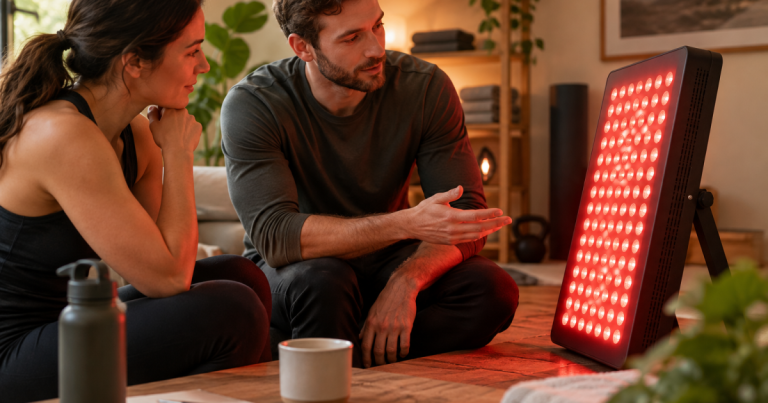
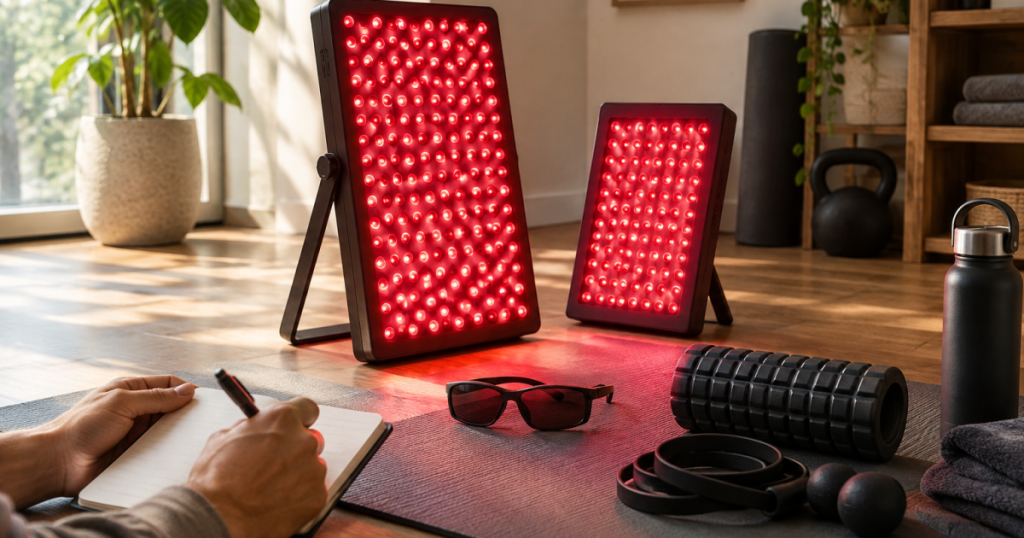
A red light therapy product page can make power look simple: more watts, more LEDs, more intensity. In practice, panel watts vs irradiance is a comparison between electricity going into the device and light arriving at your skin. Those are related, but they are not interchangeable. If you are choosing a panel for a desk corner, bedroom recovery spot, or home gym routine, the useful question is not “which number is biggest?” It is “which number best describes delivered light over the area I plan to use?”
What to know first
Watts and LED count can help you understand a panel’s format, but they do not prove how much red or near-infrared light reaches the body. Irradiance is closer to the delivered-light question because it describes optical power at a surface, usually reported in milliwatts per square centimeter. Even then, irradiance needs context: distance from the panel, measurement method, beam angle, wavelength mix, and the size of the treatment area can all change how meaningful the number is.
A buyer-safe hierarchy looks like this: start with the panel’s coverage class and wavelength profile, then examine irradiance reporting at a stated distance, then use watts and LED count as supporting clues. Electrical power is not the same as optical output, and a dense LED grid is not automatically a stronger or better session.
The specs are measuring different things
“Watts” sounds like the cleanest power number because it is familiar from light bulbs, appliances, and gym equipment. On red light therapy panels, it can mean several things depending on how the brand presents the spec.
- Electrical input watts describe how much electrical power the device may draw or is designed around.
- Advertised LED chip ratings refer to the theoretical rating of the LED chips, not necessarily how hard the panel drives them during normal use.
- Actual power draw is the energy the device consumes while operating, which may be lower than a simple LED-count-times-chip-rating calculation.
- Optical output is the light energy emitted by the panel, and it is always lower than electrical input because devices produce heat and other losses.
- Irradiance describes light power reaching a measured surface at a stated distance.
This is why a panel advertised with a large wattage figure can still be difficult to compare with another panel unless both brands explain what the wattage represents. A bigger electrical number may reflect a larger device, a different drive current, a different power supply design, or simply a different way of describing the LEDs.
Why LED count is useful but easy to overread
LED count tells you how many individual emitters are built into the panel. It is useful for understanding size, density, and possible light distribution. A small tabletop panel with a modest LED count will naturally cover less area than a tall panel intended for torso or full-body routines.
What LED count does not tell you is how much optical energy reaches your skin. Two panels can have similar LED counts but use different wavelengths, beam angles, drive settings, spacing, lenses, and power management. The result can be a different feel in daily use: one may concentrate light in a narrower area, while another may spread light more evenly across a wider zone.
LED count also says nothing by itself about routine fit. A compact panel may be plenty for face, neck, or targeted joint sessions. A larger panel may reduce repositioning if you want chest, back, legs, or broader post-workout use. The count is a layout clue, not a dose meter.
Irradiance is closer to the real question
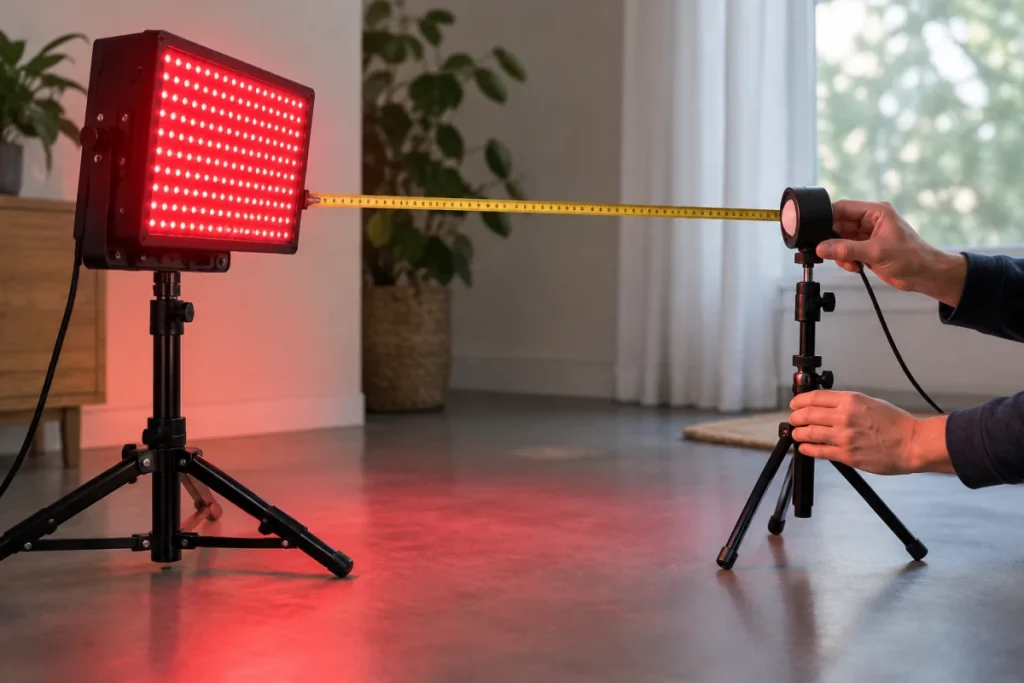
Irradiance is often the spec buyers are looking for without knowing the word. It attempts to describe how much light power reaches a defined area at a defined distance. That makes it more relevant than watts or LED count when you are trying to understand delivered intensity.
Still, irradiance numbers are only comparable when the reporting conditions are clear. A value measured at 6 inches cannot be casually compared with one measured at 12 inches. A center-point reading is not the same as an average across a broad treatment zone. A reading taken with one type of meter may not match another method perfectly. This is where spec sheets can get a little theatrical: the biggest number may be real under its test condition, yet less useful for your routine than a more plainly reported average.
When reviewing product pages, look for three details: the distance used for the irradiance claim, whether the number is a peak or average measurement, and whether the brand explains how the value was measured. If those details are missing, treat the number as a directional marketing claim rather than a precise comparison tool.
Coverage changes the power conversation
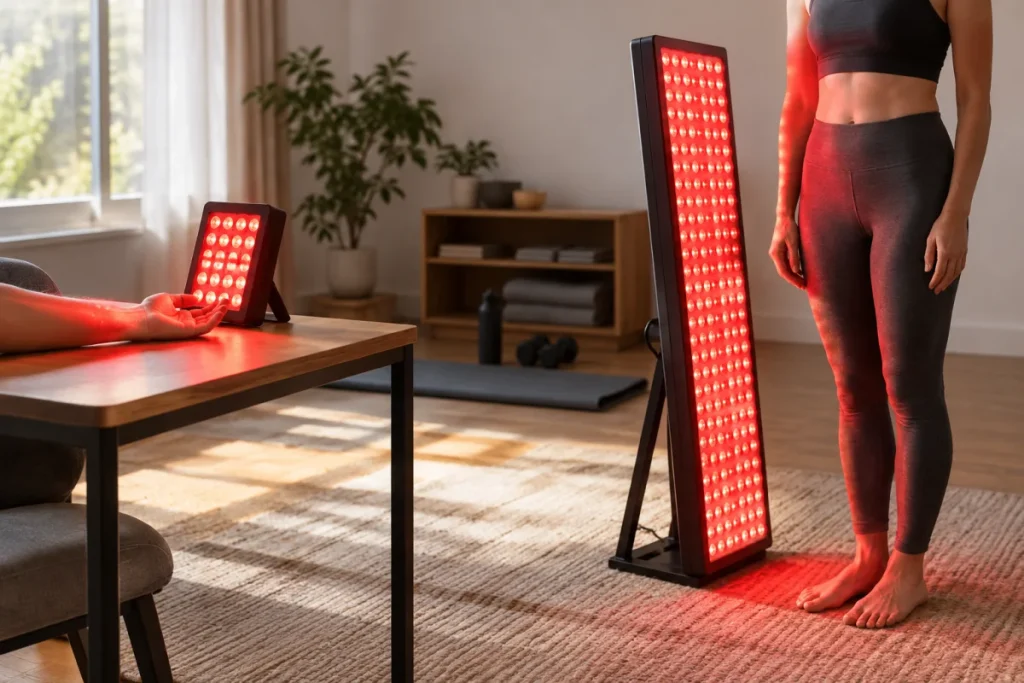
A panel does not need to be “more powerful” in every abstract sense to be better for you. It needs to deliver useful light across the area you actually plan to expose, from a distance you will realistically maintain. A narrow, intense panel can work well for a focused area. A larger panel with broader coverage may be more convenient for torso or leg routines even if its peak number is not the flashiest spec on the page.
This is where consistent product fields help. For example, a database entry for the Mito Red Light MitoPRO 750X can be more useful than a raw manufacturer headline because it places coverage class, listed wavelengths, dimensions, mounting options, and irradiance reporting in one place. You are not just asking whether a panel is strong. You are asking whether its format matches the body area, room setup, and habit you want to build.
Wavelength mix still belongs in the decision
Power specs are only part of the story. Red light and near-infrared light are discussed differently in wellness routines because they occupy different wavelength ranges and interact with tissue differently. A panel’s listed wavelengths help you understand whether it is designed around red light only, near-infrared only, or a combination.
Do not let a single power number distract you from the wavelength profile. A panel with a cleanly stated mix may be easier to evaluate than one that leans hard on wattage but buries wavelength details. This is especially relevant when comparing red and near-infrared combo panels, where the distribution across wavelengths can affect how the device is positioned for skincare-oriented, recovery-oriented, or general wellness routines.
How to read a spec sheet without getting played
Use this sequence when comparing panels:
- First, identify the intended coverage: face, targeted area, half-body, or full-body style use.
- Second, check the listed wavelengths and whether red and near-infrared channels are described clearly.
- Third, review irradiance only with its distance and reporting method attached.
- Fourth, use LED count to understand panel size and emitter layout, not delivered dose.
- Fifth, use watts to understand electrical scale, not therapeutic strength.
- Finally, consider practical ownership: stand options, mounting, room distance, session comfort, and how often you will need to reposition.
For a larger-format comparison, the Hooga ULTRA1500 listing is a useful example of why dimensions, coverage class, and mounting information should sit beside power-related claims. A big panel is not just a number on a chart; it is an object you have to place, aim, store, and use consistently.
Where watts still have value
Watts are not useless. They can help you estimate electrical demand, heat management, and the general scale of a device. If two panels are in completely different size classes, their electrical specs may confirm what your eyes already suggest. A tall multi-panel setup will generally be a bigger electrical and physical commitment than a compact tabletop panel.
Watts become misleading when they are treated as a shortcut for biological effect. More electrical input does not automatically mean a better session. It may mean more LEDs, higher drive current, less efficient conversion, wider coverage, or just a different marketing convention. For home users, the better question is whether the device can deliver a comfortable, repeatable session across the intended area without turning setup into a nightly engineering project.
What people usually ask
Is a higher wattage panel more powerful?
Not necessarily. Higher wattage may indicate a larger or more electricity-hungry device, but it does not directly prove higher optical output at your skin. Compare irradiance reporting, distance, coverage, and wavelength profile before treating wattage as a strength claim.
Does more LEDs mean better red light therapy?
More LEDs can support a larger panel or denser light layout, but it is not automatically better. Emitter quality, spacing, optics, drive settings, and usable coverage all influence the session. A smaller panel can still be the right format for targeted routines.
Should I choose the panel with the highest irradiance?
Not by itself. High irradiance can be useful, but only when the measurement conditions are clear and the coverage suits your goal. A high center-point reading may be less helpful than a more even field over the area you plan to use.
A sensible way to compare panels
The cleanest comparison is not watts versus LEDs versus irradiance as if one number can crown a winner. It is a layered read: coverage tells you how much body area the panel is built for, wavelength profile tells you what kind of light it emits, irradiance reporting gives a closer look at delivered intensity, and watts plus LED count help you understand the hardware scale.
That layered approach also keeps routines realistic. If you are building a 10-minute morning habit, a panel that is easy to place and repeat may beat one with a more dramatic spec sheet. If you are planning post-workout sessions after lifting, coverage and comfort may matter more than chasing the largest advertised number. For recovery context beyond hardware specs, the explainer on red light therapy and post-workout muscle soreness is a useful next step.
What stands out
Irradiance is usually the most relevant of the three headline power-style specs, but it still needs distance, measurement method, and coverage context. LED count helps describe the panel layout. Watts helps describe electrical scale. None of them, alone, tells you whether a panel will fit your space, goals, or routine.
The best spec reading is calm and slightly skeptical without becoming cynical. Look for clear reporting, compare like with like, and choose the format you will actually use. The strongest panel on paper is not much help if it lives in a closet because the setup is annoying.