
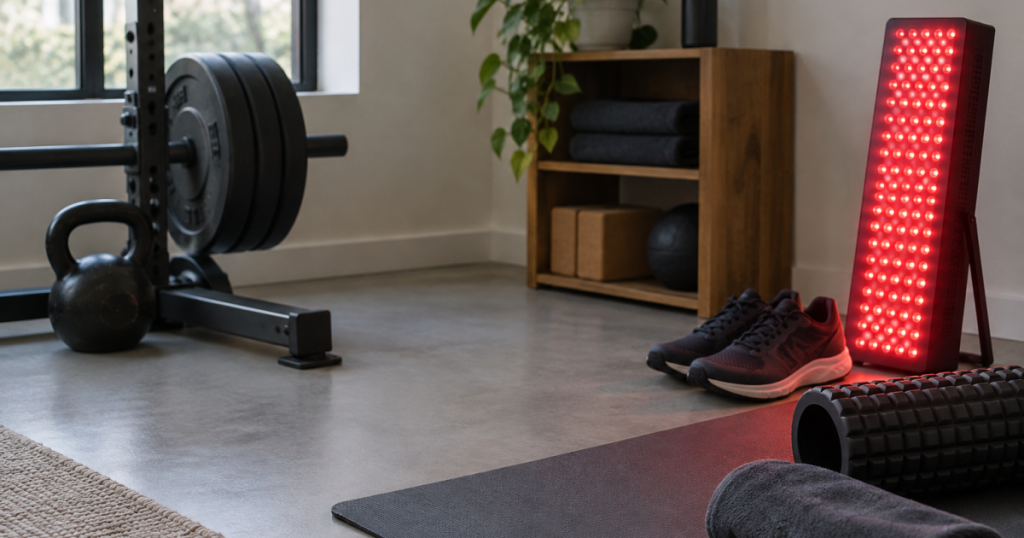
The promise behind red light therapy muscle soreness routines is appealing: less hobbling after hard training, without adding another complicated recovery chore. The more useful question is not whether light can make soreness vanish, but whether an at-home panel can be a credible support tool inside a broader recovery routine.
Health note: Diagnosis or treatment of persistent, sharp, worsening, or injury-related muscle pain should be handled by a qualified healthcare professional in line with local healthcare standards and safety requirements.
The useful answer
An at-home red light therapy panel may help reduce perceived delayed-onset muscle soreness for some exercisers, but it should be viewed as a modest recovery support rather than a guaranteed fix. The evidence is strongest for controlled photobiomodulation studies using defined wavelengths, timing, body areas, and doses; consumer panels can be useful, but their real-world effects depend on placement, coverage, consistency, and the limits of each device’s published specifications.
That distinction keeps the claim honest. Clinical and lab-based research often looks at outcomes such as soreness ratings, strength recovery, range of motion, inflammatory signaling, oxidative stress, and muscle-damage markers such as creatine kinase. Those are meaningful recovery variables, but they do not translate neatly into a promise that every home user will feel dramatically better after every workout.
The most realistic expectation is this: red and near-infrared light may make recovery feel smoother when used consistently around training, but it will not override poor sleep, aggressive programming, inadequate food, dehydration, or a workout that was simply too much for your current capacity.
Why soreness happens after a hard session
Delayed-onset muscle soreness, usually shortened to DOMS, is the tenderness and stiffness that often appears after unfamiliar or high-effort training. Eccentric work—think lowering a weight, downhill running, deep lunges, or a new tempo squat block—tends to be a classic trigger. Soreness commonly builds after the session rather than during it, and it can make stairs, overhead reaching, or even sitting down feel surprisingly dramatic.
DOMS is not the same as an acute injury. A dull, symmetrical ache after a new leg day is different from sharp pain, swelling, bruising, numbness, or a sudden loss of function. Light-based recovery routines belong in the soreness-and-stiffness lane, not the injury-diagnosis lane.
It also helps to separate soreness from performance readiness. You might feel less sore but still be under-recovered for heavy training. Or you might feel tender yet move well after a warm-up. A panel session can be one input, but your training log, sleep, appetite, mood, and movement quality all give you better context.
How red and near-infrared light is thought to help
Red light therapy is usually discussed under the broader term photobiomodulation, or PBM. In simple terms, PBM studies look at how certain wavelengths of light interact with tissue and cellular processes. The mechanisms most often discussed include mitochondrial signaling, local circulation, oxidative stress, and inflammatory pathways.
That does not mean a panel is “healing” muscle in a simple one-step way. Exercise recovery is messy biology: muscle fibers are stressed, connective tissue is loaded, the nervous system is taxed, and your body adapts over time. Light exposure is being studied as a way to influence some of those processes, not as a shortcut around adaptation.
For home users, the exciting part is practicality. A panel does not require ice baths, clinic appointments, or elaborate setup if it fits your space well. The challenge is that a convenient ritual still needs sane expectations. A bright panel in a spare corner is only useful if you can repeat the routine without turning recovery into a second workout.
Clinical PBM studies are not the same as a home panel session
This is where many soreness claims get blurry. Published PBM research may use lasers or LED devices with carefully defined parameters. The researchers can control the body area, distance, timing, exposure duration, and total delivered energy more tightly than a typical person standing in front of a consumer panel after a workout.
Home panels also vary in size, wavelength mix, beam angle, power reporting, and mounting setup. A half-body panel can cover quads, hamstrings, back, or shoulders more efficiently than a tiny tabletop device, but coverage alone is not a dose guarantee. Distance from the panel and the way a brand reports irradiance can change how comparable the numbers really are.
If you are comparing panels for recovery use, look at practical fields rather than chasing one headline spec. A page such as the Mito Red Light MitoPRO 750X listing is useful because it keeps attention on concrete comparison points: coverage class, listed wavelengths, mounting options, dimensions, and irradiance reporting. Those fields do not prove soreness outcomes, but they help you judge whether a panel fits the routine you are trying to build.
What a realistic post-workout routine looks like
For soreness support, the best routine is the one you will actually repeat. Many users place a panel near a home gym mat, stretching area, or shower-adjacent corner so the session becomes part of the cooldown instead of a separate evening chore. The ritual can be simple: train, downshift, expose the worked areas according to the manufacturer’s instructions, then move on with normal recovery basics.
Use the panel manual as your starting point for distance and exposure time. More is not automatically better, and longer sessions are not a clever way to compensate for poor placement or missed sleep. If your legs are the sore area, prioritize quads, hamstrings, glutes, and calves rather than trying to bathe the entire room in light. If upper-body training is the issue, rotate attention between chest, shoulders, upper back, arms, and any areas that usually stiffen after pressing or pulling.
Pairing the session with gentle mobility can make the habit feel more complete. Easy range-of-motion work, light walking, hydration, protein-containing meals, and an earlier bedtime are less glamorous than a glowing panel, but they are still the foundation. The panel is the recovery accessory; your body still adapts through rest and sensible loading.
Panel size, placement, and consistency shape the experience
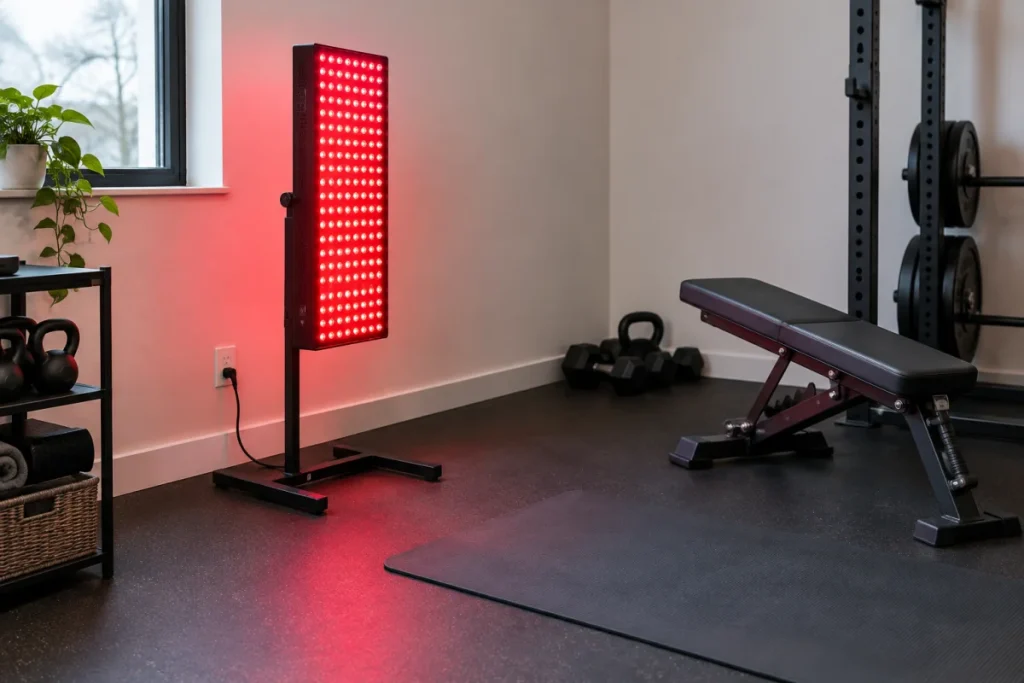
A recovery-focused setup should reduce friction. If every session requires dragging a heavy panel across the room, finding an outlet, adjusting an awkward angle, and negotiating floor space, the habit will fade. Larger panels can make lower-body and back coverage easier, while smaller panels can work well for targeted areas if you are patient and consistent.
Coverage is the first trade-off. A half-body format such as the Joovv Half-Max 3.0 gives readers a useful reference point when thinking about how much area they want to expose in one position. That does not make one format automatically superior; it means your training style should influence the setup. A cyclist with chronically worked legs, a lifter focusing on posterior-chain soreness, and a desk worker using light after mobility sessions may all prefer different panel heights and angles.
Mounting is the second trade-off. Wall mounting can be tidy, but it fixes the panel in one location. A stand can make it easier to aim at quads one day and upper back the next, but compatibility is not universal. Before assuming a stand will solve everything, it is worth checking mounting pattern, panel weight, hardware, and stability; this guide on how to check whether a third-party stand fits your panel walks through the practical details.
What not to expect from red light therapy after training
Red light therapy is not an instant soreness eraser. If you demolish your legs with a new high-volume squat workout, a panel session is unlikely to make you bounce up the stairs the next morning as if nothing happened. It also should not be used to justify stacking hard sessions when your body is asking for a lower-load day.
It is also not a substitute for progressive training. The best soreness strategy is still intelligent programming: build volume gradually, introduce new movements carefully, and leave room for adaptation. Light therapy may help you feel better between sessions, but the long game is becoming more resilient to the work itself.
Finally, avoid treating product claims as protocol. A panel page can tell you published specs. It cannot tell you exactly how your hamstrings will feel after hill sprints, how well you slept, or whether your soreness is a normal training response. That is why the smartest routines stay flexible.
Key questions answered
Can a home panel actually reduce DOMS?
It can be a reasonable tool to try for DOMS, particularly if you already value recovery rituals and can use the panel consistently. The answer is strongest when phrased carefully: some evidence supports PBM as a recovery aid, but home-panel results depend on device characteristics, setup, timing, and the individual.
Is red light or near-infrared better for muscle soreness?
Many recovery-oriented panels combine red and near-infrared wavelengths because each is discussed in PBM research and product design. Rather than assuming one label is enough, compare the listed wavelength profile and how the panel is intended to be used. The mix matters less if the panel is inconvenient enough that you rarely turn it on.
Should you use it before or after a workout?
Both pre-exercise and post-exercise PBM have been studied, and the ideal timing is not settled for every training goal. For a soreness-focused home routine, after training is the easiest place to start because it fits naturally with cooldowns, stretching, and downshifting. If you experiment with pre-workout use, keep the rest of your routine stable so you can judge how you feel.
How quickly should you notice a difference?
Do not judge it from one session after one brutal workout. A fair trial is more about consistency across several similar training weeks. Track simple signals: soreness the next morning, range of motion, readiness to train, and whether the routine is easy enough to keep doing.
In brief
Red light therapy has a credible place in the recovery conversation, but the most trustworthy answer is measured. At-home panels may help some people manage post-workout soreness, and the research around photobiomodulation gives the idea more substance than a typical wellness fad. Still, consumer panels are not identical to controlled study devices, and soreness is influenced by far more than light exposure.
The best use case is a calm, repeatable routine: choose a panel size and mounting setup that fits the muscles you train, follow the manufacturer’s guidance, keep expectations modest, and continue doing the unglamorous recovery work. When red light therapy supports movement, sleep, hydration, and sensible programming, it becomes less of a miracle claim and more of a well-designed recovery habit.