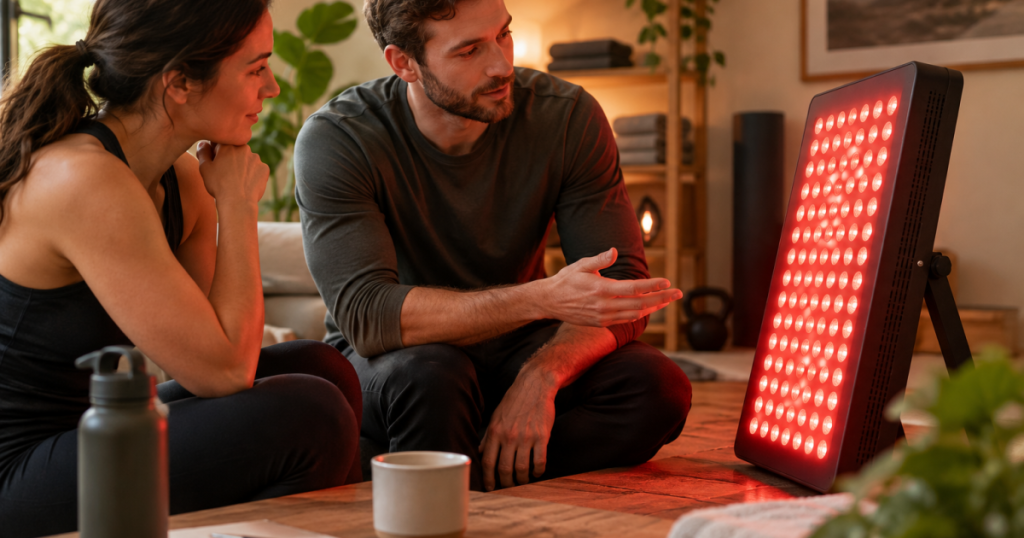
Irradiance is the spec that makes many red light panel pages feel more scientific than they really are. A panel may advertise a bold mW/cm² figure, but that number only helps when you know where and how it was measured. For red light therapy panel irradiance, the useful question is not “which number is biggest?” but “is this disclosure complete enough to estimate intensity at my working distance?”
Using a panel to address symptoms or medical conditions is a health-related decision; diagnosis and treatment planning should be handled by a qualified healthcare professional in line with applicable medical standards.
Main points
- Irradiance means optical power landing on a surface area, usually shown as milliwatts per square centimeter, or mW/cm².
- It is an intensity measurement, not a complete dose, and not a guarantee of results.
- Distance can change the number dramatically, so a claim without a measurement distance is hard to compare.
- Peak readings, average readings, red-only mode, near-infrared-only mode, and combined mode can all produce different figures.
- The most useful brands explain the measurement setup, not just the biggest number they can publish.
What mW/cm² actually means
Irradiance describes how much light power reaches a given area. In red light therapy panel specs, mW/cm² means milliwatts of optical power per square centimeter. A higher number means more optical power is reaching that measurement point at that stated distance and mode.
That last part matters. The number is only meaningful with context. “120 mW/cm²” is not a universal description of a panel. It is a reading taken under certain conditions: at a certain distance, with certain wavelengths active, using a certain meter, and often at a particular point in the beam.
Think of it like water pressure at a showerhead. The pressure tells you something useful, but it does not tell you how evenly the water covers your shoulders, whether the spray pattern is comfortable, or how long you should stand there. Irradiance is one important input in a routine, not the whole experience.
Irradiance is not the same as dose
Dose is the amount of light energy delivered over time. In simple terms, dose combines intensity and session duration. The common formula is: joules per square centimeter equals mW/cm² multiplied by seconds, divided by 1,000.
For example, a stated 50 mW/cm² exposure for 300 seconds would calculate to 15 J/cm² at that measurement point. That math is useful for understanding the relationship between time and intensity, but it should not be treated as a precise home outcome calculator. Real sessions involve distance changes, body contours, uneven coverage, clothing, angle, and movement.
This is why a slightly lower irradiance panel can still be practical if it offers better coverage, a more repeatable setup, or a distance that fits your room. A very intense reading is less helpful if the usable area is small or the brand does not explain how the reading was taken.
Why panel irradiance claims vary so much
Two panels can both publish mW/cm² values and still be hard to compare. The issue is not always dishonesty; it is often inconsistent reporting. Brands may choose different distances, meters, modes, and reporting styles. A buyer sees one clean number, but the measurement process behind it is not always equivalent.
Distance changes the reading
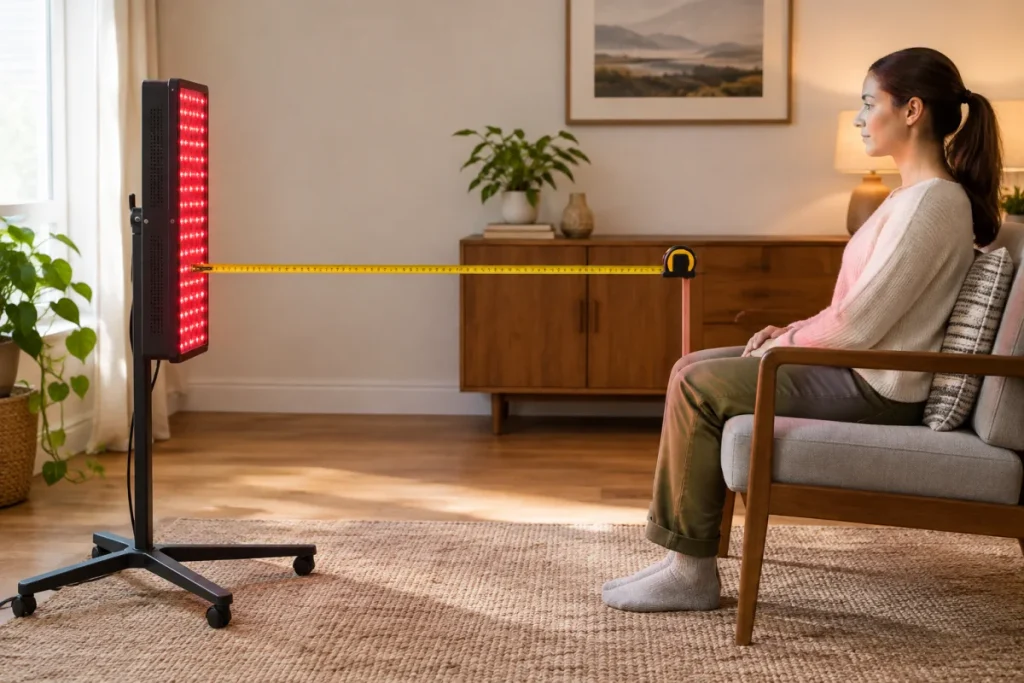
Move closer to a panel and the measured intensity usually rises. Move farther away and it usually falls. That sounds obvious, but it is the biggest reason spec sheets become misleading. A reading at 6 inches should not be compared casually with a reading at 12 inches or 18 inches.
Distance also affects coverage and comfort. Very close placement may produce a high meter reading but a smaller, less even treatment area. A more practical routine often means choosing a distance that balances intensity, coverage, heat, posture, and session length.
Peak readings can flatter a spec sheet
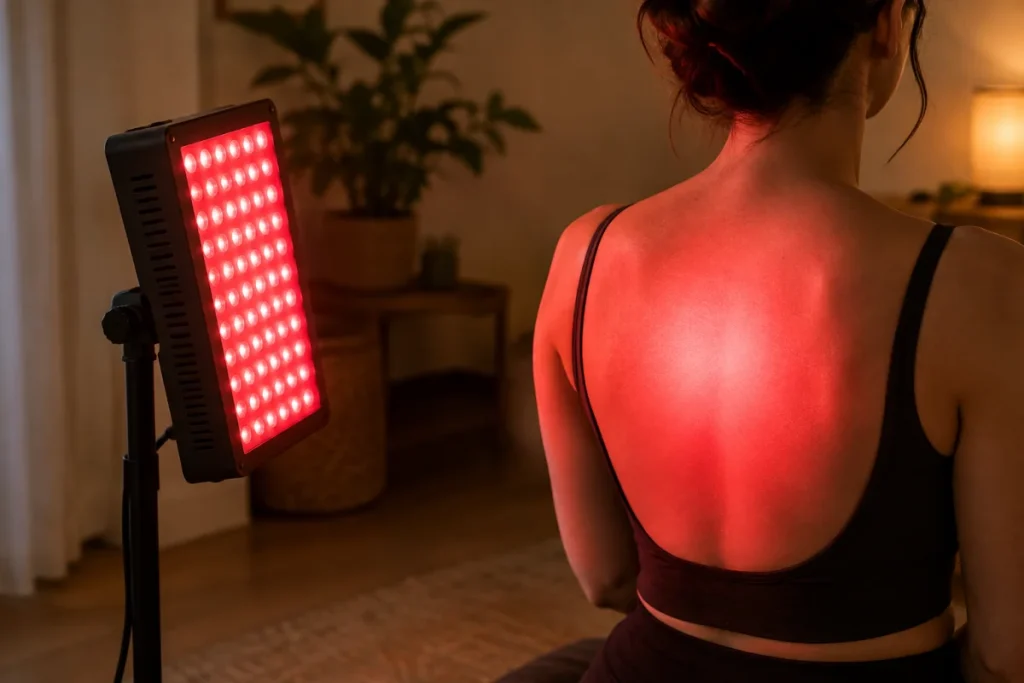
A peak irradiance claim usually describes the strongest measured point, often near the center of the panel’s beam. An average reading across a wider area is usually more relevant for body coverage because your shoulder, thigh, back, or torso is not one tiny point.
Peak numbers are not useless. They can show what the strongest part of the beam is doing. But if a brand only gives the peak reading, you still do not know how evenly the light spreads across the usable treatment area.
Red, near-infrared, and combined modes can differ
Many panels include red wavelengths and near-infrared wavelengths. A reported irradiance number may refer to red mode, near-infrared mode, or both at once. Those are not interchangeable. If one brand publishes a combined-mode value and another publishes a red-only value, the bigger number may simply reflect a different measurement setting.
When reading a product page, look for whether the listed irradiance applies to all LEDs active, only certain wavelength channels, or a specific preset. If the page does not say, treat the number as incomplete.
Meters and measurement methods are not standardized across brands
Optical measurement tools vary, and not every meter reads red and near-infrared light with the same accuracy. Some devices are better suited to specific wavelength ranges than others. Even when a brand is acting in good faith, the tool and method can influence the published number.
That is why the best spec disclosure feels a little boring in a good way: distance, mode, measurement type, and sometimes multiple readings. The more the brand explains, the less you have to reverse-engineer.
What a trustworthy irradiance disclosure includes
A useful mW/cm² claim should answer enough questions that you can compare it with another panel without guessing. It does not need to read like a lab report, but it should give the buyer more than one impressive number.
- Measurement distance: The claim should say whether the reading was taken at 6 inches, 12 inches, 18 inches, or another distance.
- Active mode: The disclosure should clarify whether red, near-infrared, or combined wavelengths were active.
- Peak or average: A peak value and an average value tell different stories. Average readings are often more useful for coverage decisions.
- Measurement area: A center-point reading is not the same as a reading averaged across the body area you plan to expose.
- Wavelength context: Listed wavelengths help you understand what kind of light mix is being measured.
- Consistency across models: Brands that report specs the same way across a lineup are easier to compare.
When browsing a specs database entry such as the Mito Red Light MitoPRO 750X, pay attention to how irradiance reporting is described alongside wavelength profile, coverage class, dimensions, and mounting options. The number becomes more useful when it sits inside a fuller panel picture.
How to compare mW/cm² claims without getting misled
Start by matching the measurement conditions as closely as possible. A 12-inch combined-mode average should be compared with another 12-inch combined-mode average, not a 6-inch peak reading. When the conditions do not match, the safer editorial move is to call the comparison imperfect rather than crown a winner.
Next, connect the spec to your actual setup. A compact tabletop panel used close to the face is a different use case from a tall panel used for wider torso or leg coverage. The better panel is not always the one with the highest irradiance claim; it is the one whose intensity, coverage, mounting, and daily convenience align with the routine you will repeat.
Also look for consistency across the brand’s own range. If one page reports peak irradiance and another reports average irradiance, be careful. If one model lists values at multiple distances and another gives only one number, the richer disclosure deserves more confidence.
When comparing a panel such as the Joovv Half-Max 3.0 with another half-body option, the meaningful comparison is not just wattage, LED count, or a headline mW/cm² figure. It is whether the published specs help you picture the real session: how far away you stand or sit, how much of you is covered, and how consistently the output is described.
Common mistakes that make irradiance harder than it needs to be
- Chasing the biggest number: A high reading can be useful, but not if the measurement method is unclear or the coverage is too narrow for your goal.
- Ignoring distance: A number without inches attached is more marketing cue than comparison tool.
- Assuming dose is exact: The formula is tidy; real bodies and rooms are not. Use dose math as orientation, not false precision.
- Comparing different modes: Red-only, near-infrared-only, and combined readings can look very different.
- Forgetting comfort and habit: If a setup is awkward, too warm, or hard to position, the better spec may not become the better routine.
Where irradiance fits in the buying decision
Irradiance should be a filter, not the whole decision. For a face-focused routine, a smaller panel with clear distance guidance may be easier to live with than a larger device. For back, legs, or full-body sessions, coverage and mounting can matter as much as intensity. For shared household use, a setup that is quick to adjust often beats a setup that looks great on paper but takes too much fiddling.
This is where the panel category becomes more interesting than a spec race. Beam angle, panel height, stand options, controls, wavelength mix, and the space you have available all affect whether a session feels like a smooth wellness ritual or another thing to manage. The goal is not to worship the number; it is to build a repeatable setup around credible information.
For placement decisions, pair irradiance thinking with distance and timing rather than treating it separately. The site’s guide to red light panel distance and dose goes deeper on turning intensity, distance, and session length into a practical routine.
Questions people ask
Is a higher mW/cm² number always better?
No. A higher number means more measured intensity under the stated conditions, but it does not automatically mean a better panel or better outcome. Coverage, disclosure quality, wavelength mix, distance, and routine fit all matter.
Can I compare irradiance between brands directly?
Only when the measurement conditions are similar. Compare distance, active mode, peak versus average reporting, and measurement area first. If those details differ or are missing, the comparison should be treated as approximate.
Does irradiance tell me how long my session should be?
It helps inform timing, but it does not decide timing by itself. Session length also depends on distance, body area, comfort, product guidance, and personal routine. Avoid turning a single spec into a medical-style protocol.
Key takeaways
Irradiance is one of the most useful red light panel specs when it is reported clearly. mW/cm² tells you how much optical power reaches a square centimeter at a stated setup, but it needs distance, mode, and reporting context to mean much.
The smartest comparison is not “which panel has the largest number?” It is “which panel gives me enough transparent information to judge intensity, coverage, and routine fit?” That shift turns irradiance from a confusing sales figure into a practical tool for choosing and using a panel with more confidence.